


Prologue · The Slang of the Livestream
If you've ever landed on a lawyer's livestream explaining China's "aiding-and-abetting information-network crime" charge, you've heard the string of terms: running the split, the crew, clean assets, dirty assets, washing, the driver, the water house, card farmer, swap-to-U. The host usually breezes past them, treating them as jargon the audience naturally understands. But the moment you press — "what exactly do these words refer to, and how do they relate to one another?" — most explanations stall halfway.
The reason isn't hard to grasp. These words aren't scattered fragments of a single scam; they are the layered terminology of an entire cross-border money-laundering industry. Each term corresponds to a step on the assembly line, a job on the crew, a state a given asset is in. Line them up together and what you get is not a dictionary of slang but a blueprint of a production line — one that stretches from Southeast Asian scam compounds all the way to the bank card in your pocket.
This production line has blood (USDT), a riverbed (Telegram), and a credit clearinghouse (the "guarantee" platforms). It ran for many years, and at one point its scale reached a staggering figure: according to on-chain analytics firm Elliptic (later cited in the FBI's 2026 seizure action), the crypto transactions received by just one of these platforms exceeded $31 billion — 25 times the combined total of the two great darknet markets, Silk Road and AlphaBay. (Note: this is the "total transaction volume the platform handled." The U.S. Treasury's FinCEN separately determined a laundering figure that can be substantiated as illicit proceeds — "at least $4 billion." The two numbers measure different things; never mix them. See the Note on the Numbers at the end.)
This essay reconstructs it along five parallel threads: how the slang decodes, how the business runs, where the trust comes from, why the law couldn't stop it, and how it was finally taken down.
Thread One · Decoding: A Set of Slang Is a Production Line
Start with the plainest explanation. Arrange these words by their position in the flow of money, and the slang tells its own story.
| Slang | Plain meaning | Position on the line |
|---|---|---|
| Running the split (跑分) | Making the money "run" — stolen funds must be moved out immediately, passed through large numbers of personal bank cards, split and transferred layer by layer, and finally "washed clean" | The core action of the whole chain |
| The crew (车队) | The smallest operating unit for division-of-labor laundering, usually 3+ people: the driver (running deposits/withdrawals), the depositor, and the cardholder/card farmer (supplying bank cards) | The frontline fiat-side operating team |
| Card farmer / cardholder (卡农/卡主) | A person who supplies personal bank cards (their own or purchased) for the split; the more cards, and the "cleaner" they are, the more valuable | The "consumable" supply of the line |
| The driver (车手) | The person who actually executes the transfers and cash withdrawals | Frontline operator |
| The water house (水房) | The link/crew responsible for dispersing stolen funds across many cards and accounts | The splitting layer |
| The controller (操盘手) | The role that performs secondary cleaning on already-dispersed funds and coordinates the whole operation | The central dispatch layer |
| Swap-to-U / U-merchant (换U/U商) | The over-the-counter (OTC) merchant who converts fiat (including stolen funds) into stablecoins like USDT | The fiat→crypto "on-chain gateway" |
| Dirty assets / dirty U (黑资/黑U) | "Dirty money" linked to fraud/criminal records, liable to be flagged and frozen by exchanges or police | Raw material awaiting laundering |
| Clean assets / clean U (白资/白U) | Funds that have passed through multiple layers of cleaning, whose addresses are "clean," free to circulate | The laundered finished product |
| Guarantee / guarantor (担保/担保商) | The intermediary platform on Telegram that escrows funds, vouches for buyer and seller (including all sorts of gray/black-market services), and takes a cut | The credit clearinghouse of the entire black market |
Read the table as a chain: the victim's money (dirty assets) is run and split by a crew using a card farmer's cards (running the split / the water house), coordinated by a controller, and finally swapped into USDT at a U-merchant and put on-chain, then hopped repeatedly until it's washed into clean assets — and every one of these transactions is completed under the credit backing of a "guarantee" platform.
One key correction to leave here: the pricing rules for "clean assets" versus "dirty assets" are not consistent across sources. The common account is that dirty U, because it can be frozen at any moment, is bought at a discount by whoever takes it on, while clean U trades near or above market price (you can think of "cleanliness" itself as a premium). But I couldn't find a single authoritative pricing rule to back a precise exchange rate — so any specific figure you hear in a livestream ("dirty U at such-and-such a discount, clean U at a few points over") deserves a question mark; treat it as street lore, not iron law.
Thread Two · The Industry Chain: The Three-Thousand-Kilometer Journey of One Transfer
Now pull the camera back and follow one sum of money on its complete journey.
【SOURCE】 Southeast Asian scam compounds (Myawaddy in Myanmar, Sihanoukville
           in Cambodia, the Golden Triangle in Laos, etc.)
           Pig-butchering / fake investment platforms / online gambling
           → defrauding victims of their fiat
                     │
                     ▼
【FIAT SIDE】 The crew · card farmers · the water house
           Deposit stolen funds into large numbers of personal bank cards,
           break them into small amounts, evade single-card large-sum monitoring
                     │
                     ▼
【ON-CHAIN GATEWAY】 U-merchants (OTC money changers)
           Convert the split fiat into USDT, mostly over the TRC20 (Tron)
           network for easy cross-border movement
                     │
                     ▼
【CREDIT CLEARINGHOUSE】 Guarantee platforms (Huione/Haowang Guarantee,
           Xinbi Guarantee...)
           Provide "reputation backing" and dispute arbitration to
           U-merchants, data dealers, and laundering services; take a cut
                     │
                     ▼
【OBFUSCATION LAYER】 Multi-layer on-chain hopping (layering)
           USDT is split and moved repeatedly among dozens to hundreds of
           new wallets, diluting the traceability path
                     │
                     ▼
【MOUTH OF THE RIVER】 Cashed out as "clean assets" flowing back to the
           scam/gambling syndicates, or run through legitimate exchanges /
           DeFi for one more wash
There are three "whys" on this chain worth spelling out on their own; they are the technical bedrock that lets the whole system run efficiently.
Why USDT. Stablecoins combine the three properties black-market operators most need: price stability (unlike BTC, which swings wildly — good as a "settlement currency"), near-zero friction in cross-border movement, and relative anonymity. For criminal networks with Chinese ties, they carry one more layer of value — bypassing the mainland's strict capital controls and traditional bank scrutiny to move money out of the country.
Why Telegram. The channel-group-bot trio is a natural fit for this business: channels broadcast one-way to pull in and funnel new users; groups handle real-time price negotiation and dispute arbitration; bots automatically check "reputation records" and "deposit status," automating the trust mechanism that traditional black markets built on personal connections. Compared with Discord, WeChat/QQ, Telegram has looser limits on anonymous registration, group size, and cross-border access, and historically its content moderation was more permissive (only tightening noticeably after 2025).
Why "guarantee." This is the most counterintuitive link in the whole system, and the most worth digging into — the next thread is devoted to it.
(Before we step into "trust," let the camera sink all the way to the riverbed and look at the one person on this chain who is exposed on the bank, named, and unable to run — the card farmer.)
Close-Up · The Card Farmer — The Only Person Exposed on the Bank of the Undercurrent
We've laid out the whole production line, but one very common misunderstanding must be corrected on its own: many people assume everyone "running the split" is holding USDT. The opposite is true — the lowest-tier card farmer never touches a single U from start to finish. He lives in a purely renminbi world. To understand how he makes money, you first have to nail down the tiers.
One · Nailing Down the Tiers: USDT Only Happens Several Layers Upstream
Stolen funds don't turn into crypto the moment they reach the card farmer. First they are absorbed, split, and cashed out by large numbers of real-name bank cards in the renminbi world, funneled upward layer by layer; only when they climb up to the U-merchant (money changer) layer are they, for the first time, swapped into USDT and slipped onto the chain. Card farmer, water house, and U-merchant are three different jobs, three different capital bases, three different lines of work.
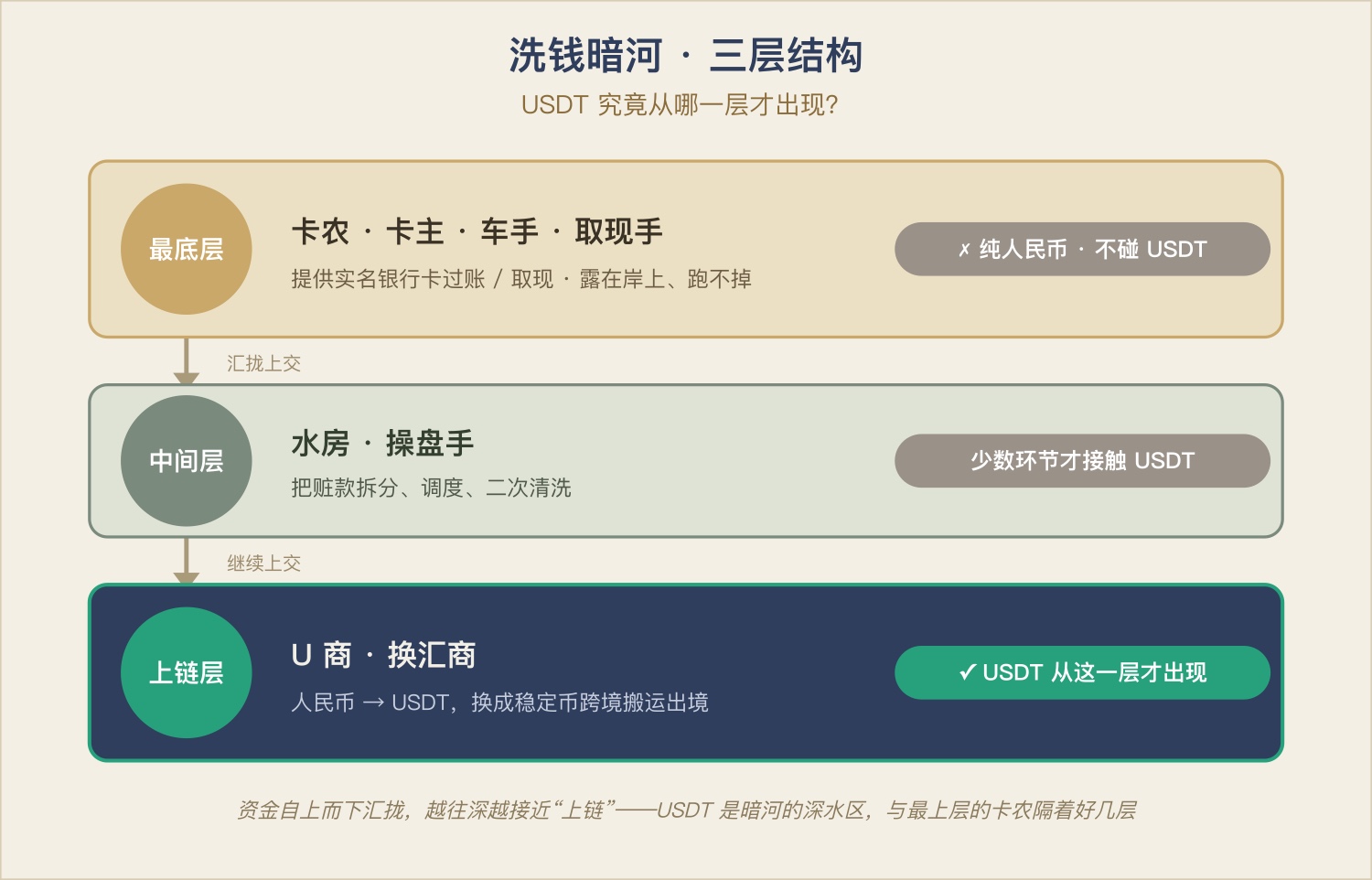
Figure 1 · Funds funnel upward from the bottom; USDT doesn't appear until the "on-chain layer" — the card farmer is several layers removed from it
| Tier | Role | What flows through their hands | Touches USDT? |
|---|---|---|---|
| Bottom tier | Card farmer / cardholder / driver / cash-out hand | RMB cash + bank cards | ❌ Never |
| Middle tier | Water house / controller | RMB, doing splitting and dispatch | Only a few do |
| On-chain tier | U-merchant / money changer | Converting RMB into USDT | ✅ On-chain starts here |
So the intuition "people running the split don't necessarily have USDT" is exactly right. The card farmer is merely the person at the very bottom of the chain who provides a real-name domestic account; going on-chain is someone else's job, several layers upstream.
Two · What the Card Farmer "Sells" Isn't Labor — It's a Real-Name Identity
To understand what lets a card farmer earn anything, you first have to understand why upstream can't do without him:
For stolen funds to land and be split, they need large numbers of real, real-name domestic bank cards. Because a single card moving large sums, across regions, with frequent transactions, will instantly trip bank risk-controls and anti-fraud systems, upstream needs hundreds or thousands of "clean, real-name, risk-control-passing" cards to disperse the money — and the card the card farmer opened with his own national ID is precisely the scarce raw material on this chain that can't be bought off a shelf, only acquired from a real person.
What he sells is not time and effort — it's the "real-name identity" itself. This is the root of the whole paradox: the person who earns the least is pledging the heaviest thing of all — his own name.
Three · Four Ways to Earn: The Four Lives of a Single Payment QR Code
The card farmer's concrete ways of making money boil down to four, all settled in renminbi:
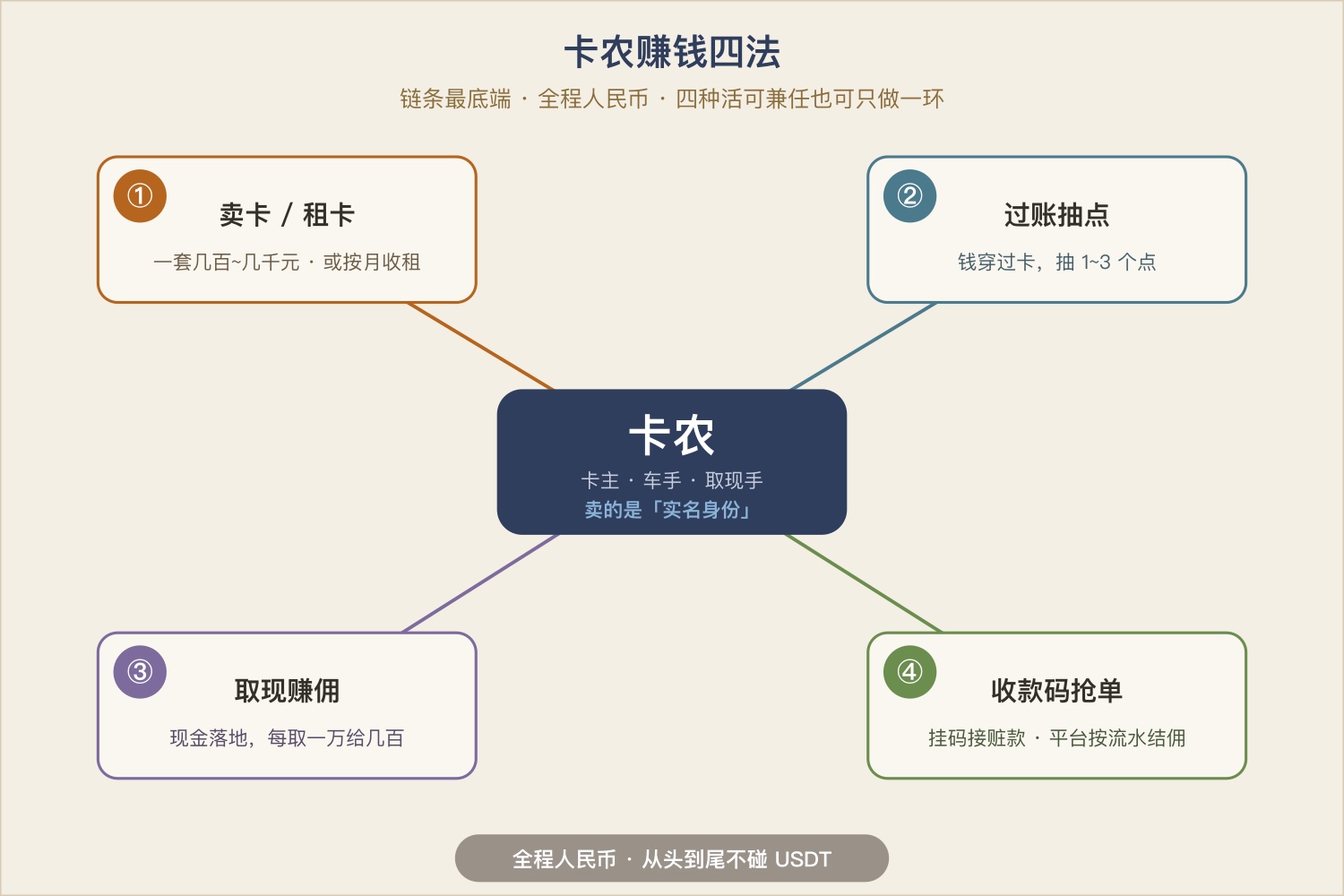
Figure 2 · The four ways a card farmer earns — one person may hold several roles, or just one link, and never touches USDT throughout
| Method | What they do | How they get paid |
|---|---|---|
| ① Sell/rent the card (most passive) | Hand over the "four-piece set": bank card + ID information + linked SIM + USB-key/online-banking; the person may not operate at all | Sold outright once, a set for a few hundred to a few thousand yuan; or a monthly rent |
| ② Pass-through cut (driver/pass-through hand) | Hold the card yourself; money comes in, gets transferred to a designated recipient | Take points: 10,000 in, keep 300 (3 points), 9,700 out |
| ③ Cash-out commission (cash-out hand/runner) | After money hits the card, go to an ATM/counter to withdraw the cash and hand it to upstream (landed cash is hardest to trace) | By trip or by ratio, a few hundred per 10,000 withdrawn |
| ④ QR-code order-grabbing (split platform) | Post your WeChat/Alipay/bank payment QR code on a split platform to "grab orders"; gambling money/stolen funds are scanned straight in | The platform settles commission on turnover (points) — the platform boss has USDT, the order-grabbing card farmer only receives RMB |
Method ④ best resolves the confusion: the split-platform boss holds USDT, but the order-grabbing card farmer receives only renminbi. The platform settles in USDT and moves cross-border at its own layer; the card farmer merely receives RMB at the very bottom with a QR code and earns a few points, never seeing a single U from start to finish.
Four · Earns the Least, Caught First: The Economics of the Bottom
The reality of this tier is especially brutal, and it's the part most worth telling ordinary people:
- Earns the least. One to three points, or a few hundred yuan for a card. The higher up the chain, the fatter the cut; the lower down, the more it's blood and sweat.
- Highest risk, caught first. The moment a victim files a report, the first thing police trace along the money flow is that real-name card that received the money — the card was opened with his own national ID; he can't run. The overseas controller is untouched; the one whose card is frozen, who is prosecuted, is always this person who made 300 yuan.
- The clawback is the full amount, not the margin. In judicial practice, recovery for "concealing and disguising criminal proceeds" reclaims the entire sum that flowed through the account, not the small commission you kept. The math thus becomes: you tried to make 300, and ended up paying back 10,000 + a prison sentence.
- The card-seller is even more wronged. After selling the "four-piece set" outright, the card is used to launder millions; months later liability traces back to the cardholder — who never even saw what those millions looked like, yet must answer for the full amount that flowed through "the account in his name."
In mainland China, taking such work carries a charge that is a ladder set by the "degree of knowledge": knowingly providing payment-settlement help while aware that others might use it for online crime → the "aiding-and-abetting information-network crime" charge (Criminal Law Art. 287(2)); knowingly helping to move what is criminal proceeds → the "concealing/disguising criminal proceeds" charge (Art. 312); deep involvement with knowledge of upstream fraud → accomplice to fraud/money laundering. And in practice, the combination of "high commission + transfers from strangers + frequent flows + not asking the purpose" leads courts to usually presume "knowledge" — "I really didn't know" is almost never a valid defense. (Specific provisions and sentencing follow the prevailing judicial interpretations.)
In one sentence: the card farmer trades his own real-name identity for a few renminbi points or some rent, absorbing, splitting, and landing stolen funds for an invisible upstream. He doesn't touch USDT, because going on-chain is someone else's job; he earns the least, yet because the card is real-name, he becomes the only person in the whole undercurrent who is exposed on the bank, named, and unable to run. This is exactly why anti-fraud campaigns keep shouting: "Two cards — never sell them, never rent them."
Thread Three · The Trust Paradox: In a Lawless World, What Keeps It From Falling Apart
The reporter's initial confusion was actually a very deep question: in an environment with no law, no court, no regulator, why would complete strangers among criminals dare to do tens of billions of dollars of business? Who proved the "guarantor" reliable? Why doesn't the guarantor himself just abscond with the funds?
The honest answer has three layers.
One · Deposit as Collateral — Trust Is "Computed," Not "Proven"
The workings of a "guarantee" platform are, in essence, a standard third-party escrow: the platform holds the buyer's money, and only releases it to the seller once the buyer confirms receipt; if there's a dispute, the platform is its own judge.
And what keeps merchants from running isn't that someone proved in advance they're "of good character" — it's a piece of collateral economics:
- To join a platform, a merchant must first post an onboarding deposit — the figures found range from 20,000 to 70,000 USDT (deposits for high-risk services like money laundering and large-value settlement are higher).
- The instant they run a scam order and flee, the deposit is confiscated and the account is blacklisted and publicly named by the platform.
- So "the payoff from cheating once" is usually less than the loss of "deposit + long-term business + reputation."
This is the same logic as a ride-hail driver fearing a ban, or a delivery rider fearing a bad review. The only difference is that here, "the platform" is the final and sole judge, with no judicial coercion behind it — it all rests on whether the platform is willing to enforce its rules.
Two · Why Is the Platform Itself Trustworthy — Survivorship Bias, Nothing More
So trace up one more layer: on what basis do users trust the "guarantee platform" itself?
The answer here will make many uncomfortable: no external institution vouches for it at all. Users trust Huione/Haowang Guarantee purely because it "handled this much volume and ran this many years without collapsing." This is classic survivorship-bias trust — the same thing as darknet markets accruing reputation by longevity. Scale itself becomes the moat: the bigger it is → the more users → the harder it is to shake with a single victim's complaint → the more reliable it appears, a self-reinforcing loop that only breaks when external force intervenes.
Three · The Darker Truth: Even the "Neutrality" Is Fake
Dig one layer deeper along the evidence chain, and you find that this "trust" doesn't even deserve the word "third-party."
- Huione Group's chairman, Li Xuan, has been identified by Chinese authorities as one of the core members of Chen Zhi's "criminal group" (he was extradited to China on April 1, 2026).
- And Chen Zhi's Prince Group is itself one of the largest operators of scam compounds in Southeast Asia.
In other words — the guarantee platform is not a neutral third party vouching for black-market merchants; it is the same criminal industry chain vouching for itself: the scam compounds are the platform's biggest client and "anchor demand," and the guarantee platform is a clearing-and-settlement layer run by their own people. Its "reliability" comes from the power structure and violent deterrence inside one and the same criminal network (break the rules and you get dealt with), not from any external oversight.
So will it actually abscond? Yes. It's just that when it collapses, users have no legal recourse. On April 27, 2026, roughly a hundred Chinese citizens gathered outside the headquarters of the National Bank of Cambodia to demand back funds frozen by Huione Pay, a payment platform under Huione Group, and clashed with police — several were injured. This was already the fourth gathering in the same wave of bank runs, its direct trigger being Li Xuan's extradition earlier that month, which suddenly left the group without its linchpin. With no civil remedy available, the money may simply be gone for good. And what truly ends an entire platform is never internal trust collapse or a user run, but the power of the state discussed below. Which precisely shows: for internal participants, this system "held up" for a very long time.
Thread Four · The Fissures in the Law: Why a Business Could Run in the Open for Years
If the first three threads answered "how it runs," this thread answers a more unsettling question: how could such a blatant business run in broad daylight for years?
The answer lies not in technology but in the structural fissures of cross-border law. There are at least four.
Fissure one: sovereignty arbitrage. Every link of the crime is carefully sliced across different jurisdictions. Victims are in China, the U.S., Europe; scam compounds are in the "no-man's-land" or semi-autonomous zones of Myanmar, Cambodia, Laos; settlement platforms are registered in Phnom Penh; servers and money are on-chain and offshore. No single country's police can, on its own jurisdiction, take down the whole chain in one blow — territorial jurisdiction, pitted against cross-border crime, is congenitally crippled.
Fissure two: the crime-corruption complex. This isn't "criminals evading the government" — in some places, crime is the local economy itself. By the U.S. Institute of Peace's (USIP) estimate, the scam industry across Cambodia, Myanmar, and Laos generates about $43.8 billion a year, nearly 40% of the three countries' combined GDP; Cambodia alone earns roughly $12.5 billion a year from scams, more than half its formal economy. When a "business" feeds half a country's fiscal base and a large slice of the local elite, expecting local law enforcement to fight it is like expecting it to sever its own revenue. Researchers have coined a term for this condition — "Scam States": crime and corruption in collusion, anti-money-laundering enforcement already failed at the source.
Fissure three: the stablecoin regulatory blind spot. Traditional laundering has to pass through banks — banks have KYC, SWIFT, freezable accounts. But USDT moves on-chain, passing through no bank that owes any duty to a customer. Although issuer Tether can in theory freeze specific addresses, against a daily deluge of transactions passed through many layers of hopping, after-the-fact freezing can never catch up with real-time movement. Stablecoins drop the cost of "moving large sums cross-border" to nearly zero, and pare the regulator's grip down to nearly nothing.
Fissure four: the platform's "technical neutrality" disguise. A guarantee platform can publicly argue that it "merely provides matchmaking and escrow tools and isn't responsible for the content of transactions" — this "I'm just a platform" rhetoric happens to lodge in the gray zone of many countries' current laws on "accomplice" liability. To prove the platform knowingly assisted laundering requires cross-border evidence-gathering, on-chain analysis, and undercover intelligence — an extremely high bar. This is exactly why taking it down ultimately required not ordinary criminal prosecution but the unconventional weapon of sanctions law (see the next thread).
Stack these four fissures together and you have the answer: it could exist for so many years not because it hid well, but because the existing legal toolbox was simply never stocked with tools fit for a crime that spans a dozen-plus jurisdictions, settles in stablecoins, and parasitizes corrupt economies.
Thread Five · The Investigation and the Dragnet: How a Net Encircled a River
So how was it finally taken down? This is the most dramatic part of the whole story — it wasn't the feat of one cop or one undercover operation, but a converging chain of "on-chain analysis → investigative media → think-tank characterization → state power closing the net," each link interlocking with the next.
Baton one · The on-chain analytics firm moves first (July 2024). Blockchain analytics firm Elliptic published the original report, systematically lifting the veil on Huione Guarantee's role for the first time — because however anonymous USDT is, it leaves a permanent trace on the public chain. On-chain analysts followed the money flow, strung wallet after wallet into a network, and estimated the astronomical volume the platform matched. This is the starting point of the entire reporting thread, and the hardest source of evidence: chat logs can be deleted, on-chain flows cannot.
Baton two · Investigative media pick it up (from the second half of 2024). ProPublica dug into how Southeast Asian casinos serve as laundering guarantors; Wired exposed Huione's ties to Cambodia's ruling family; Reuters reported the staggering combined volume of Huione plus Xinbi. On-chain data + fieldwork + victim testimony, cross-referenced, restored an abstract "number" into a flesh-and-blood picture of crime.
Baton three · Think tanks add the "human" dimension (2024–2025). Reports from USIP, the U.S.-China Economic and Security Review Commission (USCC), and others turned the lens on the heaviest facet — there are more than 150,000 people in forced labor inside these compounds. Scamming is not merely financial crime; its foundation is human trafficking and forced labor. This characterization provided the moral and legal grounds for "striking with the heaviest legal instruments" that followed.
Baton four · The platform is driven out of its riverbed (May 2025). Telegram carried out a mass ban of Huione, Xinbi, and related channels and accounts. The riverbed was pulled out, but the undercurrent didn't dry up — it merely shifted into more hidden channels.
Baton five · State power closes the net — the day three arrows fired at once (October 2025). This was the real hammer blow, and a combination punch packaged for a single day. Here is how the timeline interlocks:
- May 1, 2025, FinCEN first issued a Notice of Proposed Rulemaking (NPRM) warning; on May 13, Telegram cooperated with the bans (see Baton four).
- October 14–15, 2025, the U.S. and U.K. launched the largest joint action in the history of Southeast Asian cybercrime, with three arrows firing at once:
- The DOJ (U.S. Department of Justice) unsealed, in the federal court in Brooklyn, New York, the indictment of Prince Group chairman Chen Zhi — conspiracy to commit wire fraud + conspiracy to launder money, charging him with running forced-labor scam compounds in Cambodia; simultaneously it launched the largest asset forfeiture in U.S. history, seizing roughly $15 billion in Bitcoin (127,271 coins) tied to the compounds.
- OFAC (the Treasury's Office of Foreign Assets Control) imposed sweeping sanctions on the Prince Group criminal network.
- FinCEN issued a Final Rule under Section 311 of the PATRIOT Act (signed October 15, published in the Federal Register on the 16th, effective November 17), cutting every entity of Huione Group — Haowang Guarantee, Huione Pay, Huione Crypto, and the rest — off from the U.S. financial system.
- January 6, 2026, Chen Zhi and two associates, Xu Ji Liang and Shao Ji Hui, were arrested in Cambodia (officially announced on the 7th) and subsequently extradited to China; Chen Zhi's Cambodian citizenship was stripped.
- June 2026, the dragnet entered the mop-up phase: the DOJ seized Huione's cloud accounts (part of Operation Riptide), and FinCEN extended the "primary money-laundering concern" designation to H-Pay Service PLC — the shell successor Huione set up to evade being cut off.
What's telling is the weapon combination of the closing net: not a lone criminal verdict, but criminal prosecution, astronomical asset forfeiture, OFAC sanctions, and a Section 311 financial cutoff, all four at once. This precisely bears out the judgment of Thread Four — against a crime that is cross-border, parasitic, and disguised as "technically neutral," any single conventional criminal tool falls short; only by binding together instruments at the level of a "financial nuclear weapon" can the whole net be made unable to move an inch within the global dollar system.
Epilogue · The Undercurrent Rerouted, Never Dried Up
Told this far, it reads like an ending where justice finally arrives. But the truth is far colder.
After the Telegram bans, follow-up tracking by on-chain analytics firms Elliptic and TRM Labs pointed to the same conclusion: this undercurrent didn't dry up; it merely rerouted. And "rerouted" is nearly literal — after Huione was delisted, large numbers of merchants were guided to migrate to Tudou Guarantee, a platform in which Huione itself held roughly a 30% stake (acquired in December 2024). Tudou quickly siphoned off the traffic and matched about $12 billion (Elliptic's figure — briefly the third-largest illicit marketplace in history; RUSI separately estimates $14.6 billion) in transactions, until it was shut down in January 2026 under Chinese law-enforcement pressure. The undercurrent was not filled in; it merely flowed into a new channel dug by the same boss.
The broader numbers are equally cold. Chainalysis, in a report at the end of January 2026, estimated that the Chinese-language money-laundering network (CMLN) handled roughly $16.1 billion in crypto over 2025, averaging about $44 million a day — and this figure does not yet include the transaction volume of the guarantee platforms themselves (guarantee platforms don't directly handle transactions, only matchmaking, so they're excluded); the real scale of the ecosystem is only larger.
Why can't it be killed? Because not one of the four legal fissures above has been patched: sovereignty is still fragmented, the corrupt economies still exist, stablecoins are still a regulatory blind spot, and the "technical neutrality" rhetoric still works. What you take down is one specific platform, not the structure that breeds platforms. As long as the demand (scam compounds) and the soil (the cross-border legal vacuum) remain, supply will keep reviving under a new alias.
For ordinary people, the existence of this undercurrent means two very concrete things:
- The "guarantee" you see in a Telegram group isn't guaranteeing you. That system of deposits, reputation, and arbitration is a trust tool built for transactions among black-market insiders. As an outsider pulled in to do a "guaranteed transaction," what you usually face is a secondary scam designed with exactly this rhetoric — escalating layers of "security deposit" and "penalty fee," and then everything vanishes at once.
- Don't become that "consumable." Renting out, lending, or selling your own bank card, SIM, or payment QR code looks like earning a little "handling fee," but it is in fact the "card farmer" at the very bottom of the production line. In China, this constitutes the crime of aiding-and-abetting information-network criminal activity ("aiding-and-abetting charge") — the real controller is far overseas, and the ones arrested, sentenced, and clawed back from are usually these frontline people who thought they were "just doing a favor."
Lawyers keep explaining this slang in their livestreams not out of morbid curiosity. They are showing you the waterline of this undercurrent — making clear where it comes from, where it goes, and who gets drowned in it.
Appendix · An Honest Note on the Numbers
The place this kind of reporting most easily goes wrong is the numbers. Different institutions use different definitions, time windows, and statistical scopes; they cannot be simply added together or directly compared. To avoid misleading, here are the sources and boundaries of the key numbers, laid bare:
| Number | Meaning | Source / definition | Caveat |
|---|---|---|---|
| $11B → $24B → $31B+ | Huione Guarantee's cumulative crypto transactions received, the same metric evolving over time (first exposed 2024.7 → 2025.1 → at forced delisting) | Elliptic on-chain estimate; the $31B version was later cited in the FBI/DOJ 2026.6 seizure release | This is "total transaction volume handled," not "illicit proceeds"; the "25× Silk Road + AlphaBay" line (Silk Road ~$216M, AlphaBay ~$1B) comes from the $31B version |
| ≥$4B | The laundering amount determined by FinCEN and substantiable as illicit proceeds (2021.8–2025.1, including North Korean hackers, etc.) | FinCEN Section 311 Final Rule (2025.10.15) | Measures something entirely different from the row above: this is the "determined laundering amount," the one above is "transaction volume handled" — never mix or add them |
| ~$103B | Crypto cumulatively received by Huione's payment arm, Huione Pay | Elliptic | Payment-arm scope, yet another layer; do not add to the $31B guarantee-arm figure |
| ~$134B | Huione's entire network combined (guarantee + payment + others) | Elliptic (cited by the FBI) | Network-total scope, already includes the $31B and $103B above — do not stack again |
| ~$12B / $14.6B | Tudou Guarantee's matched volume before delisting (the successor platform ~30% owned by Huione, shut down 2026.1) | Elliptic reports $12B (third-largest in history) / RUSI reports $14.6B | The two definitions diverge; cite the source when picking a value |
| $8.4B | Xinbi Guarantee's illicit transactions since 2022 | Elliptic | Xinbi alone |
| $16.1B | Crypto handled by the Chinese-language money-laundering network (CMLN) over all of 2025, ~$44M a day | Chainalysis (2026.1.27 report) | Excludes guarantee-platform transaction volume (guarantee platforms don't directly handle transactions); service-provider-side scope |
| ~$15B / 127,271 BTC | Bitcoin seized with the Chen Zhi indictment by the DOJ, the largest forfeiture in U.S. history | DOJ (2025.10) | A different thing from platform transaction volume; don't conflate |
| ~$43.8B/year | Annual output of the scam industry across Myanmar, Cambodia, Laos, ~40% of the three countries' combined GDP; Cambodia ~$12.5B/year | USIP estimate | Macro estimate, carries significant uncertainty |
| 150,000+ | Number in forced labor in Southeast Asian scam compounds | USAID / USIP estimate | A lower-bound estimate |
Note: Elliptic's combined estimate for Huione's entire network is about $134 billion (already including Huione Pay's $103B). Any higher claim of "$400 billion / 400 billion" exceeds this ceiling and is very likely a definitional confusion or a garbled retelling; this essay does not credit it. Any citation of a specific number must return to the FinCEN Final Rule (published in the Federal Register 2025.10.16), the DOJ indictment, and the original Elliptic / Chainalysis reports for line-by-line verification — this appendix has been re-checked accordingly.
Appendix · Further Reading and Primary Sources
Investigative reporting (narrative templates)
- ProPublica — Southeast Asian Casinos Emerge as Major Enablers of Global Cybercrime
- Wired — investigation into Huione Guarantee's political-business ties in Cambodia
- Reuters — reporting on the combined volume of Huione + Xinbi Guarantee
- Zeke Faux — Number Go Up (2023), the book that first systematically put crypto scams and Southeast Asian compound forced labor on the table (verify edition details yourself)
Think tank / policy research (macro framework)
- USIP — The Latest on Southeast Asia's Transnational Cybercrime Crisis
- Scam States: The Cybercrime-Corruption Complex in Southeast Asia
- USCC — China's Exploitation of Scam Centers in Southeast Asia (2025/7), and researcher Jason Tower's successive congressional testimonies
On-chain technical breakdowns (primary data)
- Elliptic — original July 2024 report (first exposure of Huione Guarantee)
- Elliptic — Behind the FBI case against Huione: the $134 billion marketplace (2026.6, with a breakdown of the $31B / $103B / $134B definitions)
- Elliptic — Tudou Guarantee winds down after $12 billion (2026.1)
- Chainalysis — 2026 Crypto Money Laundering report (2026.1.27, CMLN $16.1B)
- TRM Labs — The Scam Center Strike Force
- Recorded Future — Evolution of Chinese-Language Guarantee Telegram Marketplaces
- RUSI — Multi-Billion Dollar Guarantee Marketplaces Exploit Stablecoins for Scams
- SlowMist — Technical Research Report on Stablecoin Anti-Money-Laundering and Compliance Paths, and its public malicious-address database
Official primary documents (most authoritative citations)
- DOJ indictment — Chairman of Prince Group Indicted... (2025.10) + ~$15 billion BTC forfeiture
- FinCEN Section 311 Final Rule — Federal Register 2025.10.16, Imposition of Special Measure regarding Huione Group (signed 2025.10.15, effective 11.17)
- FinCEN — 2026.6 extension of the designation to H-Pay Service PLC (the shell successor entity)
- U.S. Treasury / OFAC Prince Group sanctions press release (2025.10)
This essay is a secondary synthesis and popular re-creation based on public investigative reporting, think-tank research, on-chain analysis, and official judicial documents; all facts and figures are traceable to the public sources listed above. It contains no non-public information and constitutes no operational guidance of any kind.