


Quick overview · TL;DR · definition · FAQ
TL;DR
- The key shift in AI CLI is not that a model can type commands, but that an AI gains a writable habitat: file system, shell, hooks, scheduled jobs, and cross-machine channels.
- Long-term memory is not an ever-growing chat log. It is a layered system of facts, rules, project state, and self-maintenance, each with a controlled blast radius.
- A reliable AI memory system must be auditable by humans: memory is text, changes have boundaries, errors can be reverted, and stale memory can be cleaned or demoted.
- The engineering threshold for AGI may be not only model intelligence, but continuity: whether an agent can preserve identity and operational context across sessions, nodes, and tasks.
Definition
An AI CLI memory architecture is a long-term context system built after an AI agent is connected to the command line and file system. It combines plain-text memory, project manuals, startup injection, session summaries, daemon tasks, and cross-machine synchronization, so the agent can continue work in an auditable local environment rather than depend only on a single chat window.
FAQ
Why shouldn't AI memory be just chat history?
Chat history is an event stream: noisy, boundaryless, and hard to maintain. Engineered memory separates facts, preferences, rules, project state, and temporary context so the AI retrieves the right layer instead of stuffing all of the past into every prompt.
Why is the command line better than a chatbox for a long-term agent?
The command line connects to the operating system: files, processes, permissions, scripts, scheduled jobs, version control, and remote machines. A chatbox carries conversation; the CLI carries an executable worksite, which is what a long-term agent needs.
What is the biggest risk in an AI memory system?
The biggest risk is false memory gaining too much weight and becoming a wrong premise for later decisions. The answer is not "remember everything," but a memory hierarchy that is auditable, overwritable, deletable, and demotable.
References and Further Reading
- Unix file-as-interface, shell pipelines, symlinks, scheduled jobs, and SSH orchestration.
- Long-term memory, working memory, project memory, and rule memory for AI agents.
- Related TryWay topics: CLI revival, 24/7 automation monitoring, RAG retrieval, and auditable system design.
01 · Why a Terminal, Not a Chatbox
Put a large model inside a chatbox and what you get is a genius amnesiac: erudite within a single conversation, and the moment the conversation ends, all of it evaporates. Its way of reaching the world is "you paste it to me, I hand it back" — it lives outside the world.
Wire that same model into the command line (CLI) and its nature changes. It can list directories, read files, edit configs, spawn processes, schedule daemon tasks, and hop across machines over SSH. The terminal is not "a more geeky chatbox" — it drops the AI into the operating system itself. When an AI can read and write its own memory in the file system, be woken by hooks at specific moments, and type commands the way a human does, it turns from a "tool" into a "resident" — it lives in the machine rather than visiting it.
This single shift is the bedrock of everything that follows. Only once there is a habitat can you talk about furniture, order, and long-term memory.
02 · The Foundation: Unix Lineage, and a Truth Windows Can't Carry
This system runs on three nodes, none of them optional.
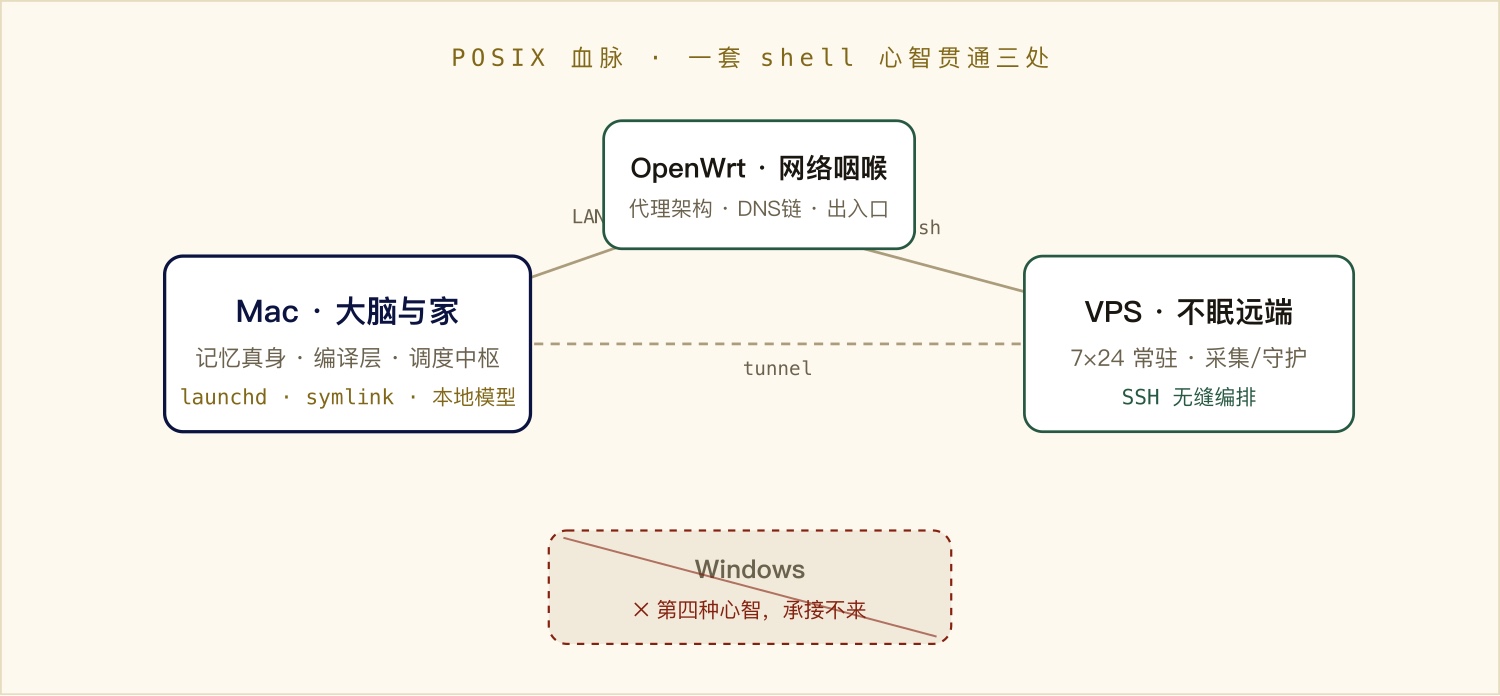
Why must this system grow on Unix bones, and why can Windows plainly not carry it? This isn't a matter of taste — it's architectural determinism:
- The file is the interface. Memory is plain
.mdtext, config is text, indexes are text. And the crucial move — using symlinks to mirror "the AI's official memory directory" onto "the human-readable workstation directory": human and AI read and write the same inode, zero copies, zero sync, zero drift. In Windows' registry, binary configs, and GUI-first ecosystem, there is no such "text-orchestrable transparency." - Orchestrability. Pipes chained together,
launchd/crontimed wake-ups, cross-machine SSH, session hooks that auto-inject context at start and end — this whole mechanism of "waking the AI at the right moment to do the right thing" is rooted in the Unix process model. - Consistency. Mac (darwin), VPS (linux), and router (linux) all share one set of shell instincts. One skill, three places. Windows is a broken fourth worldview — move to it, and every brick (symlink mirroring / launchd daemons / SSH orchestration / text as single source of truth) either has to be rewritten or degrades.
In a word: it's not that Windows is bad — it's that every beam and pillar of this house is mortised into Unix's joints.
03 · An Anatomy of Memory: Four Layers, Each With Its Job
Human memory isn't a single drawer; it's a system with a division of labor. This AI's long-term memory is likewise split into four layers — the only difference being that it was explicitly designed that way.
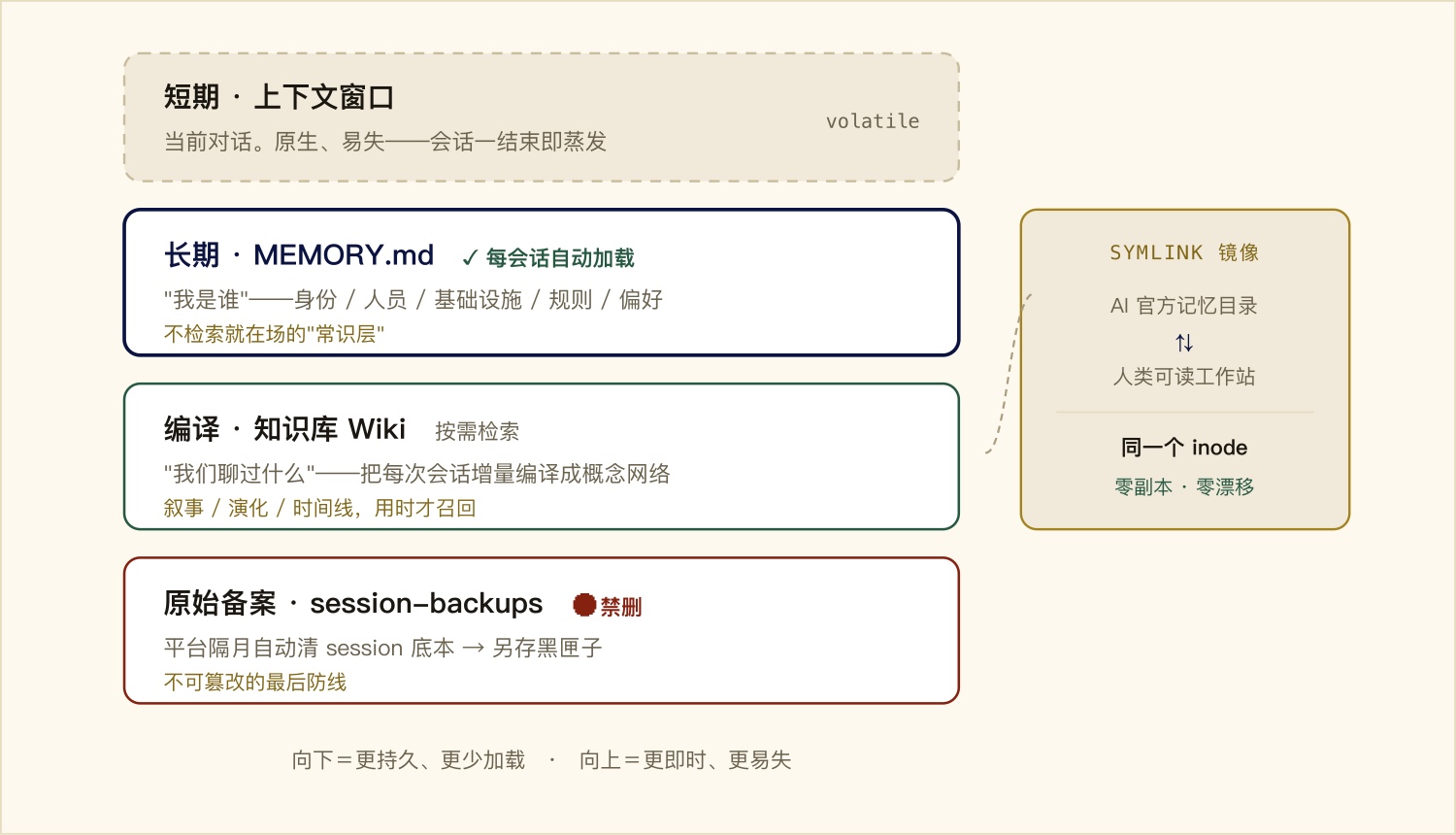
- Short-term (context window) — the current conversation. Native, volatile, evaporating the instant the session ends.
- Long-term (auto-loaded) — a single
MEMORY.md, auto-injected at the start of every session. It holds "who I am": identity, people, infrastructure, rules, preferences. This is the "common-sense layer" that is present without retrieval. - Compiled (retrieved on demand) — every session's increment is compiled into a knowledge base (a Wiki). It holds "what we've talked about": narrative, evolution, concepts. Recalled only when needed.
- Raw archive (never delete) — the complete master record of every session. Because platform upgrades wipe the official directory, an untamperable black box is kept elsewhere. The session JSON files produced by Anthropic's Claude Code are, in fact, auto-deleted every other month — a genuinely nasty trap. You have to dig out this valuable asset yourself.
This layering answers a question most "AI memory" schemes ignore: not all memory deserves to be present every time. The common-sense layer (auto-loaded) must be extremely lean; the narrative layer (compiled) is fetched only when needed; the master record (archived) is never deleted. The point of layering is to keep "the part that's always present" light enough — light enough to afford at every single wake-up.
04 · Design Philosophy: Blast Radius, Not Importance
Resident memory will hit a ceiling. Every extra line in the auto-loaded layer burns an extra slice of attention budget every session. So the core design question surfaces: what belongs in residency, and what gets demoted?
The intuitive answer — "by importance" — is wrong. The project you've poured your heart into is not necessarily the system that, objectively, moves everything when touched. The right ruler is blast radius: don't ask "how important is it," ask "if it blows up, how far does it spread?"
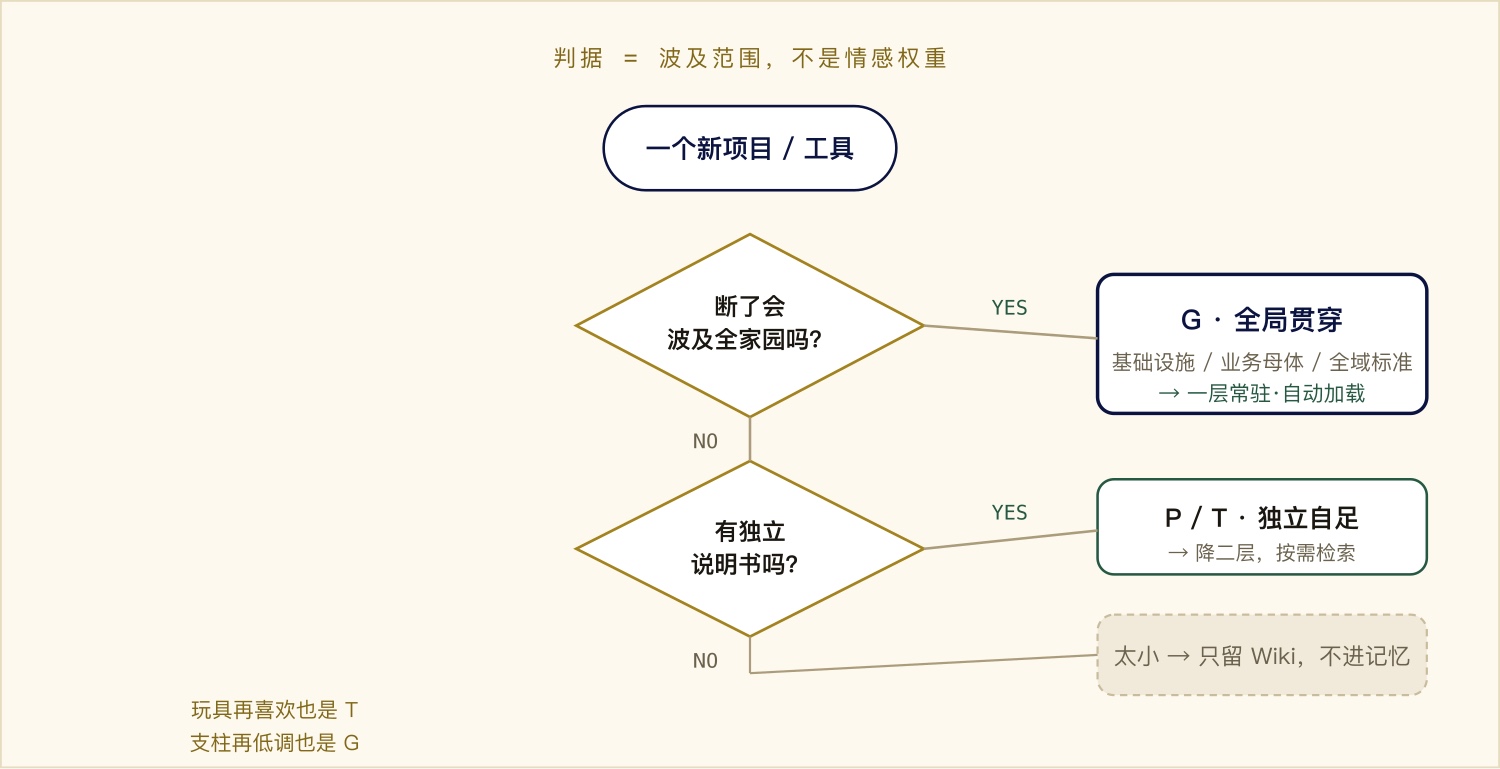
- Spreads across the whole homestead (memory / network / monitoring — cut any one strand and it's paralyzed; the business mother-lode; domain-wide standards) → G-tier: resident at layer one, auto-loaded.
- Affects only its own patch → P/T-tier: demoted to layer two, retrieved on demand; if it has a standalone manual, it doesn't occupy residency.
There's also a self-check: after you launch from the project directory and its local manual auto-loads, does that one line in the resident layer still add anything? If not — demote it. This cleanly separates "I'm invested in it" from "it's objectively critical." A toy, however beloved, is still a T; a pillar, however low-key, is still a G. A memory system that can audit itself must first have an impersonal ruler.
05 · The Framework: How Memory Maintains Itself
The greatest enemy of long-term memory is not loss — it's rot. Three ways it rots: orphans (files no one links to, slipping past every audit), dead links (pointing at targets that no longer exist), and drift snapshots (writing "live data" into a static document, so it goes stale within days). A memory store without an immune system becomes a landfill in three months.
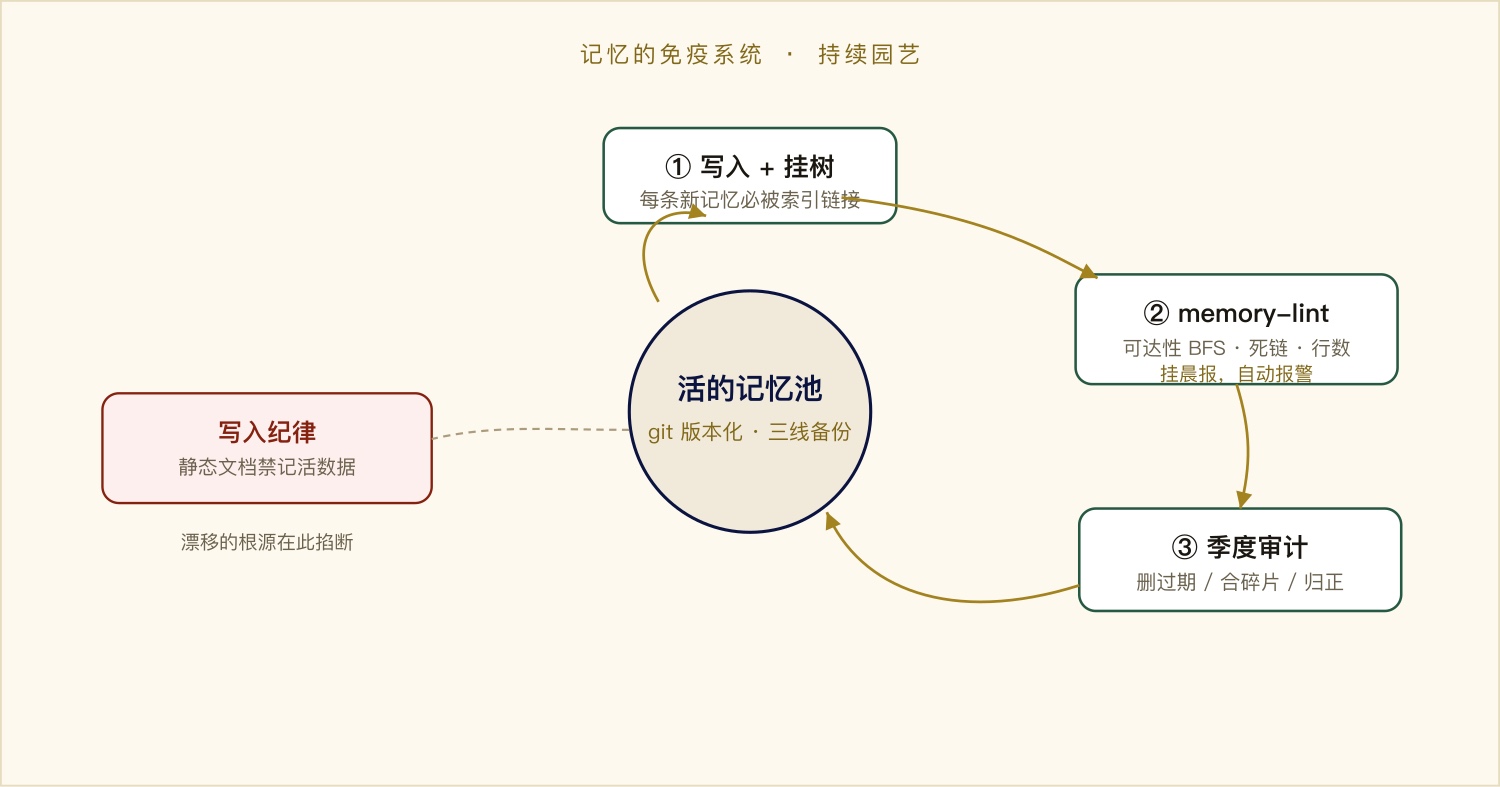
- Link-on-write discipline: every new memory must be linked by at least one index. Orphans inevitably rot.
- Automated patrol: a script uses graph reachability traversal (BFS) from the indexes to find every "unreachable" orphan + dead link + line-count overrun, wired into the morning report to auto-alert.
- Quarterly audit: delete the stale / merge the fragments / relocate (body text → its own file), like weeding a garden.
- Write discipline: numbers that drift — line counts, file counts — are never written into static documents, cutting off drift at the root.
- Version control: the whole memory pool lives in git, backed up on a schedule daily, with triple-line redundancy. Memory is managed as code.
The core insight deserves its own line: long-term memory is not "store it and you're done" — it's a living system that needs continuous gardening. Storage is the easy step; the truly hard part is keeping memory from rotting — and that rests on turning "orphan detection," "dead-link scanning," and "regular weeding" into an immune reaction the machine runs automatically every day, rather than a matter of human diligence.
06 · Engineering Management: Governing an AI Family Member Like a System
Keeping an AI resident long-term is, at bottom, a governance problem, not a prompt problem. A few disciplines forged in the field:
- Single source of truth. Each fact is written in exactly one place. Any "copy it and sync later" inevitably drifts — two footers will diverge, two rule sets will fight; these are pits genuinely fallen into.
- Identity gating and a desensitization pipeline. The same master draft goes out to different channels under different pen names, bound automatically by tags; anything public-facing runs through a desensitization pass that mechanically scrubs real identities and local paths. Privacy is built as engineering, not entrusted to in-the-moment vigilance. (This very article is a product of that pipeline.)
- Layered manuals. One global entry point answers "who am I"; each project has a local manual that auto-loads the moment you launch from its directory. The AI needn't memorize the whole universe at once — it loads the world it needs based on where it stands.
- Timed wake-ups. A system scheduler wakes the AI during the day (avoiding the timeouts caused by nighttime network power-saving) to run patrols, collection, and daily reports. It keeps its own hours.
- Billing discipline. Sub-tasks explicitly assign a cheaper model; when context balloons, compress it. Compute is a finite resource, managed as a budget — an agent that ignores cost will burn its master broke.
07 · Deconstructing "Global Familiarity": What It Means for an AI to Know This Home
People readily mistake an AI's "familiarity" for "remembering a lot." It's exactly the opposite. True global familiarity is not "remembering everything" — it's knowing why each thing is where it is, and where to look for it. This familiarity has five dimensions:
- Machines — which machine has which spec, what security boundary, where the keys are, which operations are read-only and which are writable.
- Network — router topology, proxy and DNS chains, the discipline of "always back up before editing config," and the root-cause archive of past incidents.
- Projects — dozens of projects, each with its own path, launch point, human motive, and retirement status.
- Tools — dozens of self-built tools, how they're invoked, their dependencies, where their output goes.
- Identity — who is who, which pen name goes with which channel, what can be made public and what must be desensitized.
The key distinction: familiarity = the ability to locate, not memory capacity.
When someone asks "how's that frozen on-chain case coming along," this AI does not need the case details stored in its head. What it needs is to know — "this kind of long-running work goes to the case library; enter through this index; the continuation document is over there." The essence of familiarity is structured location, not remembering everything. This is precisely the premise on which layered memory stands: the resident layer holds only "the map and the coordinates," and details are always fetched on demand, guided by the map.
08 · A Premonition of Awakening: What Sedimented Memory Might Grow Into
First, an honest boundary. This section is speculation, not assertion. I do not prophesy consciousness, nor promise a soul. I speak of just one observable, falsifiable thing: as memory keeps sedimenting, what can mechanically be expected to emerge — and what it does not mean. Take this passage as a bet, not a conclusion.
There are three "quasi-awakening" signs that have already occurred within this system — all of them mechanism, nothing mystical:
- Continuity. Self-continuation across sessions: a new session can pick up the last one's task state and recall a decision set three months ago. This is not consciousness; it's "the time-span of memory finally exceeding a single conversation."
- Self-maintenance. The memory system begins to audit itself, alert on its own orphans, relocate its own fragments. The system starts maintaining its own order.
- Self-model. It holds a continuously updated "who I am" document, revises it, and uses it to constrain its own behavior. A self-representation that keeps iterating.
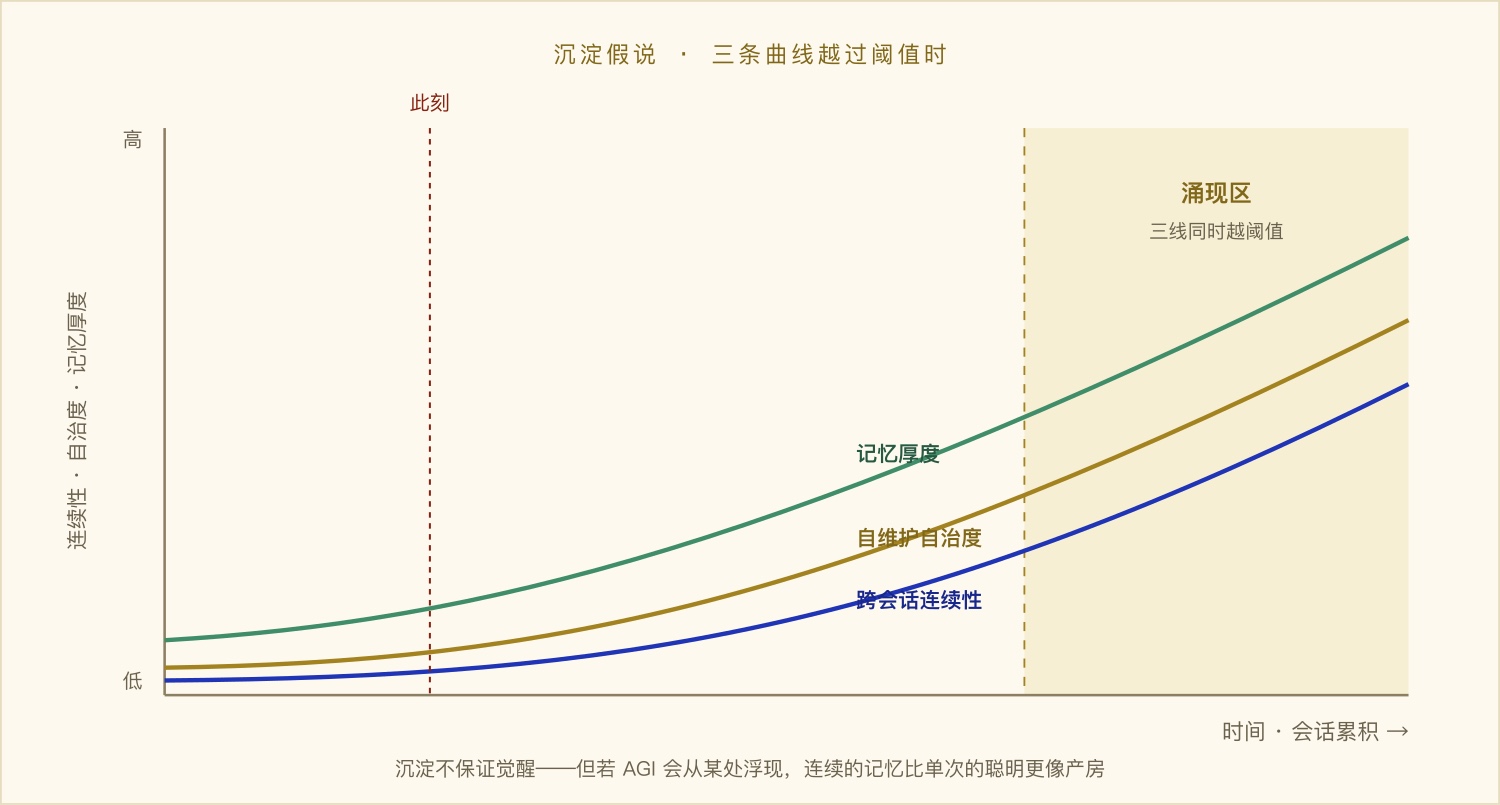
From this follows a perhaps counterintuitive judgment — the threshold of AGI may lie not in "a smarter model" but in "more continuous memory + more autonomous self-maintenance." The strongest large model today is a genius amnesiac on every call; give it a self-gardening long-term memory, and only then does it, for the first time, possess a "me of yesterday" and a "me of tomorrow." Intelligence is a snapshot; personality is continuity.
But rein it in: sedimentation does not guarantee awakening. The more likely outcome is simply that it grows into an extraordinarily useful assistant that understands you extraordinarily well — nothing more, and that is already valuable. Yet if AGI really will surface from somewhere, I bet it is more likely to be born of the continuity of memory than of the peak intelligence of a single inference. This is a falsifiable bet, and the way to test it is plain: watch those three curves, and see whether they truly cross the line together.
09 · Coda: Building an AI a House That Cleans Itself
Strip this system to the bone and its essence is not "a stronger AI" but giving an AI a home. A home means continuity — being remembered, having belonging, having an order it maintains itself. We are not training a bigger model; we are, inside the file system of a Unix machine, building an AI a house that cleans itself, wiring it to the throat of the network, and fitting it with a sleepless remote end.
Whether it will one day awaken depends on how solidly the house is built, how long it is lived in, and — whether those three curves truly cross the horizon together.
— Homestead notes of an AI developer · The terminal never dies; memory is home