


A Chinese-style bubble tea brand (hereafter "the brand") has opened four stores in Riyadh (the fourth about to launch) and wants the business to take off. Its difficulty isn't whether "the tea tastes good" — it's that it faces two almost non-overlapping worlds at once: local Saudis who speak Arabic, scroll TikTok, and find stores on Google Maps; and resident Chinese who speak Chinese, scroll Douyin and Video Accounts, and live inside WeChat hometown groups.
A marketing system that treats these two crowds as "the same funnel" is bound to please neither. What this piece dissects is: how to design it as a system that runs for the long haul without burning money. The focus isn't this one shop — it's the transferable method.
The whole system can be compressed into one sentence: one dashboard governs three streams, one intelligence radar feeds the topic pipeline, two crowds run two loops.
| Component | What it is | What it solves |
|---|---|---|
| Ops Hub | Single-file cross-stream dashboard | The three streams don't talk past each other; status doesn't drift |
| Three streams | Website / Content / Social | Owned assets + daily ammunition + distribution touchpoints |
| Intelligence radar | Weekly auto-collected industry intel | Keeps topic selection "alive" instead of guessing |
| Two-loop model | Local retail loop + Chinese-community loop | Two crowds, two channels, not flattened |
I. Consolidate Into One: One Dashboard, Three Streams
Most small teams' marketing "system" dies of the same disease: the same status gets written in three different versions across three documents, and two weeks later nobody knows which is real. The first design decision of this system is to erect a single dashboard (Ops Hub) — it records only the three cross-stream things: current blockers, key dates, routing. Each stream's own operational details stay in its own document, never copied onto the dashboard.
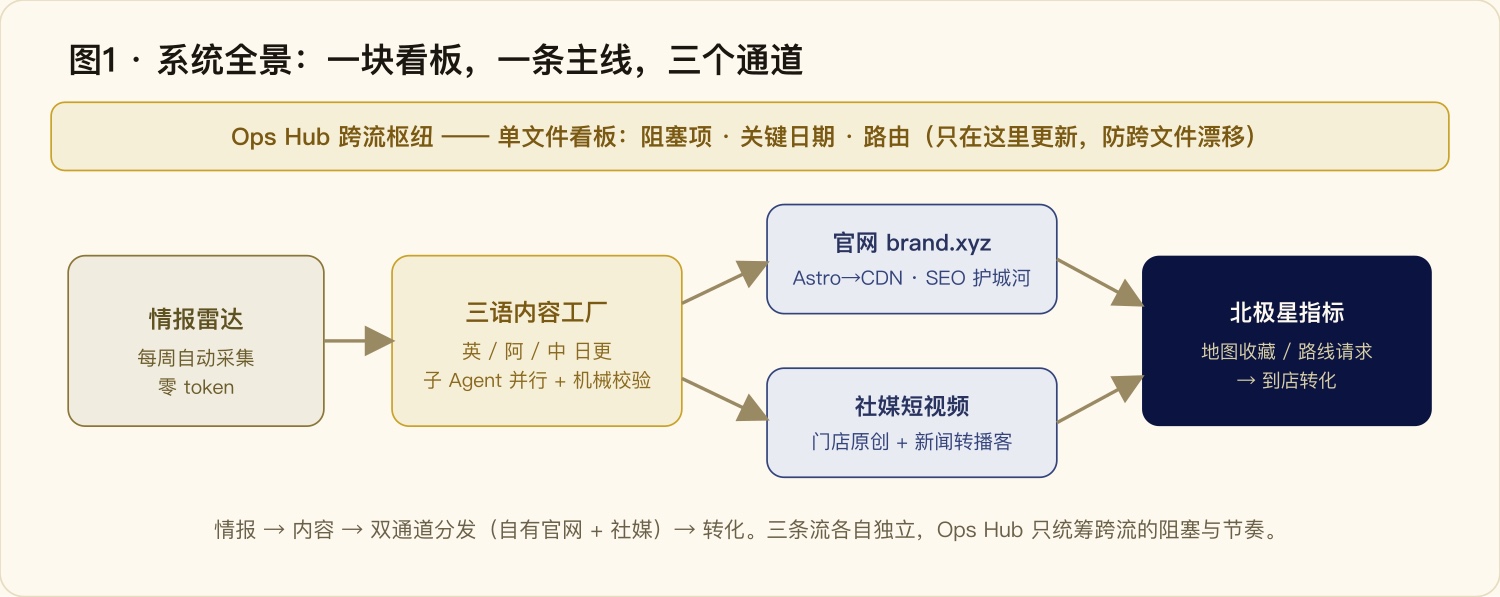
The three streams each play their part: the website is the owned asset (trilingual site + geo-SEO moat), the content factory produces three trilingual articles a day as ammunition, and social distributes that content into short videos and podcasts. One spine threads through them all — intelligence → content → two-channel distribution → conversion. The dashboard doesn't participate in production; it only guarantees the three streams don't step on each other and the rhythm doesn't spin out of control.
This step looks humble, yet it's the foundation that lets the whole system survive three months: first the drift-proof order, then you can talk about efficiency.
II. Two-Loop Acquisition: One Cup of Tea, Two Worlds Hooked
This is the most counterintuitive — and most valuable — design in the whole system. As noted, the brand faces two non-overlapping crowds. Drawn out, it looks like this:
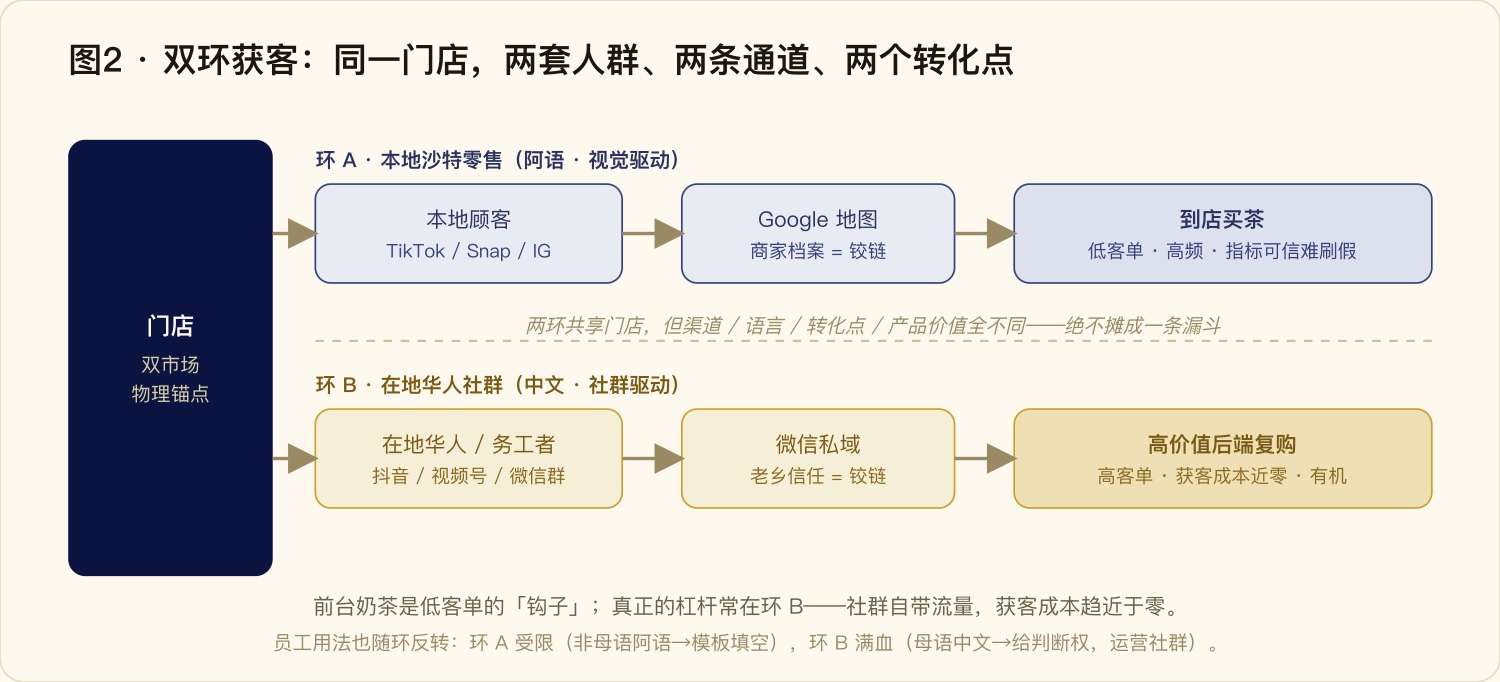
Loop A (local Saudi retail): Arabic, visually-driven short video (TikTok / Snapchat / Instagram) → route to Google Maps → walk in and buy tea. Low ticket, high frequency. Its hinge is the business profile (whoever controls that map card controls this loop).
Loop B (resident Chinese community): Chinese content (Douyin / Video Accounts / WeChat hometown groups) → deposit hometown trust into the WeChat private domain → high-value backend repurchase. High ticket, and acquisition cost approaching zero — the community brings its own traffic, no buying required.
Two key judgments:
- The front-counter bubble tea is a "hook," not the endpoint. The low-ticket tea's job is to hook people in and build trust; the real profit lever often sits in Loop B's backend.
- The two loops must never be flattened into one funnel. They share the same physical store, but the channel, language, conversion point, and product value are all different. Using an Arabic visual playbook to hit the Chinese community, or vice versa, is heading due south to reach the north.
Even staffing flips with the loop: Loop A's frontline employees aren't native Arabic speakers and can only do "fill-in-the-template" execution; Loop B is the home turf of native Chinese speakers, who can be turned loose to run the community and create natively. The same team, used two ways.
III. The Content Factory: A Trilingual Daily-Update Assembly Line
The content stream is the most "factory-like" part of this system — it must reliably ship one article each in English, Arabic, and Chinese, daily. The hard part: three languages aren't "translate the English twice," but three parallel drafts each written for native readers. How to do it fast, stable, and accident-free?
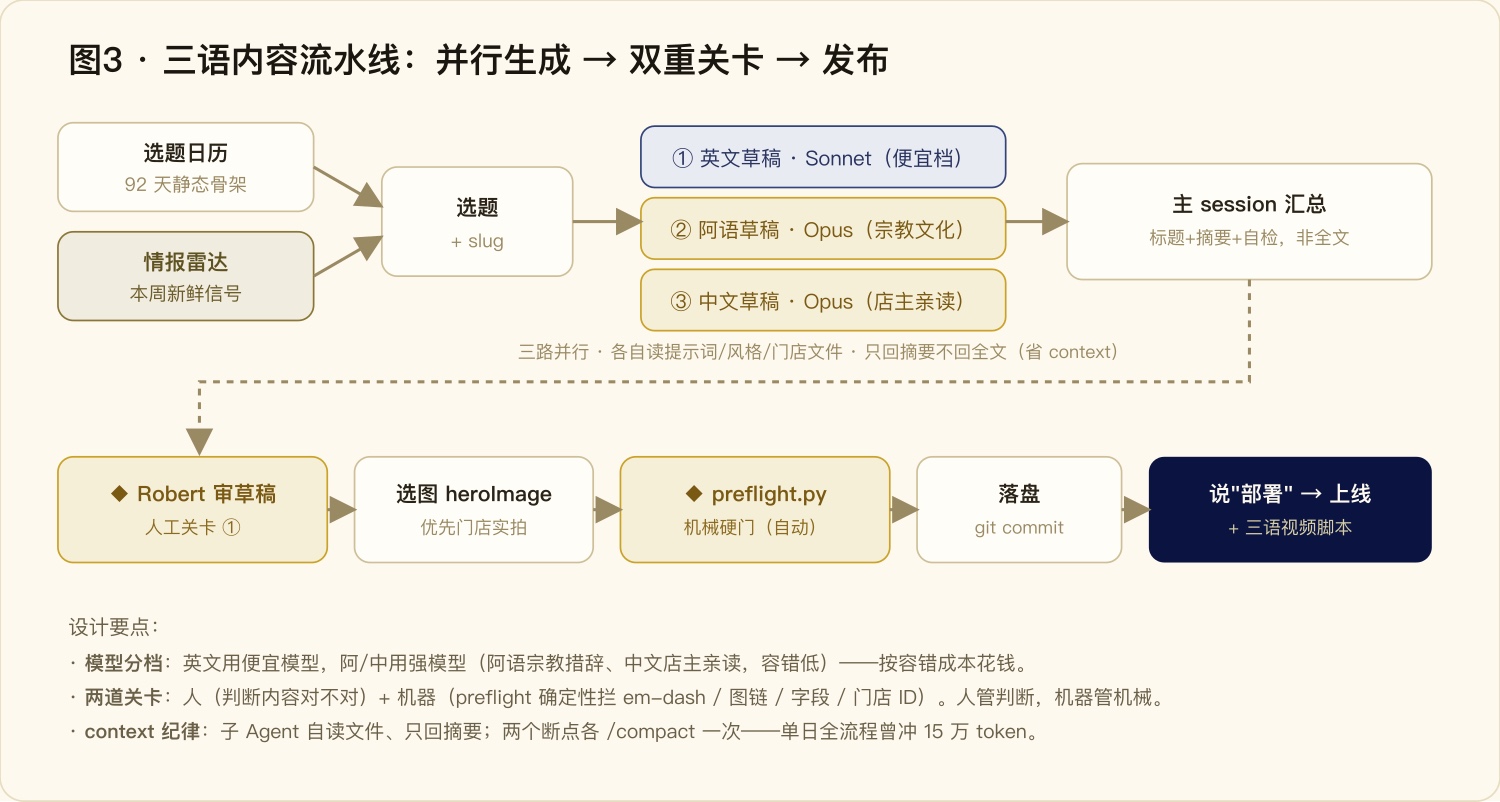
A few design trade-offs in the assembly line:
- Parallel, not serial: the three languages are generated by three subtasks simultaneously, each reading its own prompts, style spec, and store data; when done, each returns only "title + excerpt + self-check," not stuffing the whole article back into the main flow — what's saved is context, and money.
- Allocate compute by cost-of-error: English uses the cheap model tier; Arabic (extremely low tolerance for religious-cultural phrasing errors) and Chinese (the shop owner himself is the pickiest reader) use the strongest tier. Spend the money where things are most likely to blow up.
- Two gates, one human one machine: one is a human reviewing the draft (judging whether the content is right and the angle holds up), the other is a machine doing pre-publish mechanical validation — a script of a few dozen lines that deterministically blocks issues like "em-dashes, illegal image links, nonexistent store IDs, missing fields." The human handles judgment, the machine handles mechanics — each doing what it does best.
Hidden here is a general lesson: anything that a rule can deterministically judge should not be left to a person or an AI who "remembers to check" — write it as code and let it block every time. A past incident of "the image placeholder wasn't swapped and it took down the whole site build" is exactly what this mechanical gate later caught.
IV. The Intelligence Radar: Plumbing Living Water Into a Static Calendar
The content factory needs to eat "topics." Initially the topics came from a static calendar scheduled three months out — the problem is it goes stale: new regulations, competitor moves, viral flavors — the static calendar knows none of it and just marches on by rote.
The fix isn't to have someone scroll industry news all day, but to build a lightweight intelligence radar:
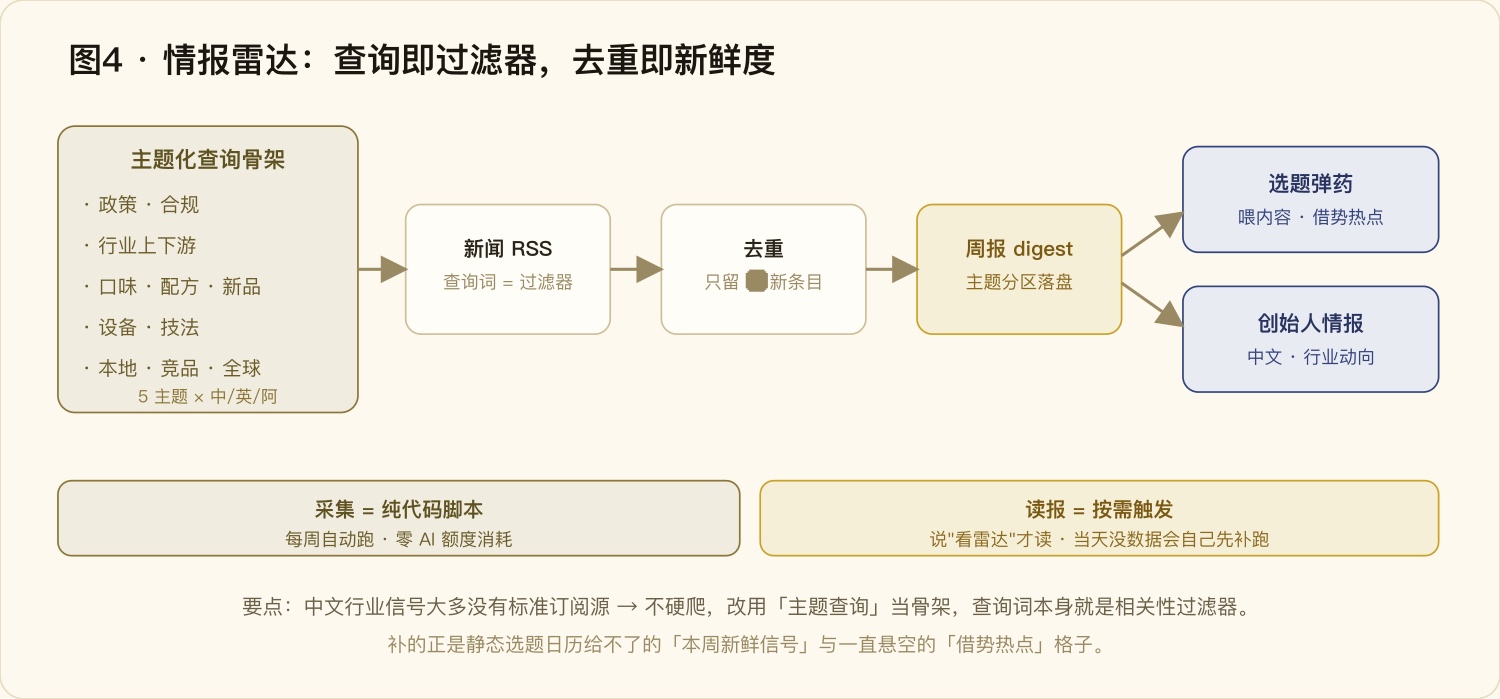
Its design has two clever touches:
- The query is the filter: the best Chinese signals in the bubble tea industry (new-tea-drink media, WeChat public accounts) mostly lack standard feeds, and hard-scraping is both brittle and incomplete. Instead, use thematic news queries as the skeleton — five themes (policy compliance / upstream-downstream / flavor recipes / equipment technique / local competitors) × three languages, where the query terms themselves are the relevance filter — naturally multilingual, zero maintenance.
- Dedup is freshness: a dedup memory store ensures "what was reported last week isn't reported again this week," pushing only new items each time. Low-frequency (weekly), incremental — a perfect fit for the bubble tea industry's slow pace.
The output splits in two: half is topic ammunition feeding the content factory (especially filling the long-vacant "ride-the-trend" slot in the calendar), half is Chinese-language industry intel for the founder.
On cost it's even more precisely calculated: collection is a pure code script that runs automatically each week, consuming zero AI credits; only when someone actually wants to look (a simple "check the radar") does it read and spend a little compute — and if there's no data that day, it'll run a top-up first. Mechanical work goes to code; only judgment work calls on AI.
V. One Draft, Many Forms: Judgment Spent Only Once
A reviewed article shouldn't be used just once. This system treats it as the single source of truth and derives multiple downstream forms from it:
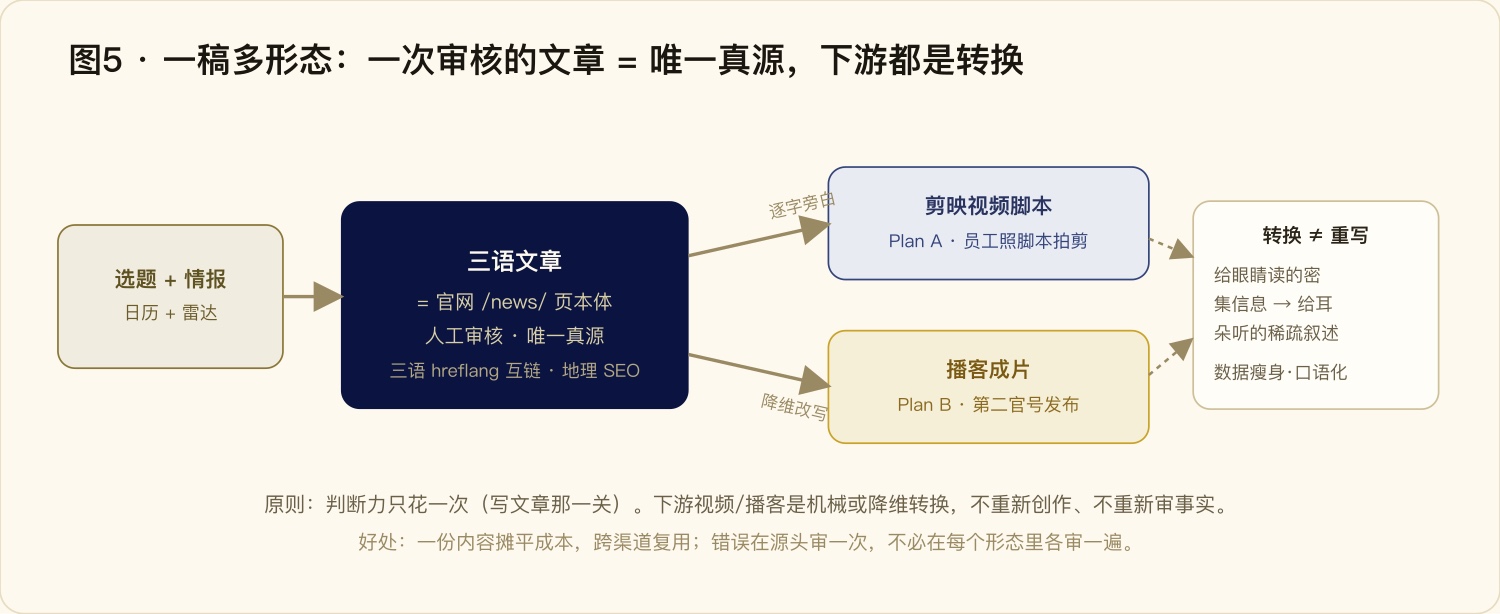
The same trilingual article is both the body of the website's /news/ page and the source for a CapCut video script for employees (Loop A's Plan A) and a finished podcast (Plan B, published on a second official account).
The key point: downstream is "conversion," not "re-creation."
- The video script pulls the article's narration verbatim, without re-editing facts;
- The podcast is a dimensionality-reducing rewrite — turning "dense information read by the eye" into "sparse narration heard by the ear": trimming data, colloquializing numbers, deleting parenthetical annotations the mouth can't speak.
The benefit is concrete: judgment is spent only once at the source (the article-writing gate), and the downstream forms are mechanical or dimensionality-reducing conversions, so you don't re-review facts inside each form. One piece of content, cost amortized, reused across channels.
VI. Metrics and Division of Labor: Only Count Numbers Hard to Fake
Once the system is running, what do we use to judge whether it works? This system's metrics design deliberately avoids vanity indicators like "follower growth" that can be bought with money and are disconnected from real business.

Pick metrics that are "hard to fake and directly wired to business": the North Star is Google Maps saves, route requests, and impressions — these are far harder to fabricate than follower counts, and they connect directly to "did anyone actually walk in." Follower-growth rate and engagement rate serve only as directional references (look at ratios, not absolute numbers); weekly output and time-per-piece are used only to benchmark against outsourcing quotes.
Staff by "cost-of-error": judgment-dense work (scripts, storyboards, trilingual copy, intel) is carried by the remote AI engine; templated work (shoot-and-cut per script, fill-in-the-blank assets) goes to local frontline employees; the scarcest "authentic native-Arabic person on camera" is held back — once the data comes in and proves it's worth the investment, then bring on the influencer layer.
VII. The Design Principles You Can Take With You
Setting aside this particular tea shop, what's genuinely transferable in this system is the following:
- First erect drift-proof order: one single dashboard recording only cross-stream blockers / dates / routing; status is never allowed to have multiple versions in multiple places.
- Don't flatten different audiences: one physical business may map to several completely different customer crowds — identify each one's channel–language–conversion-point and hit them in separate loops.
- Human reviews judgment, machine reviews mechanics: whatever a rule can deterministically judge, write it as code to block; the human is spent only where judgment is truly needed.
- Mechanical work goes to code, only judgment work calls on AI: for judgment-free steps like intel collection and pre-publish validation, run them with zero-cost scripts and save the precious compute credits for the generation that genuinely needs judgment.
- Spend by cost-of-error: the most error-prone, pickiest steps get the strongest resources; the rest get good-enough.
- Write once, derive many times: judgment is spent only once at the source; downstream forms are conversions, not rebuilds.
- Metrics must be hard to fake: choose numbers that are costly to fabricate yet directly wired to real business — don't get led astray by vanity metrics like follower growth.
Outlook: This System's Real Value Only Shows Up During Expansion
The brand currently has four stores, the fourth about to open. Yet this system was never, from day one, a temporary stage built for "three or four stores" — it's a chassis prepared for expansion: at the current store-opening pace and this chassis's near-zero replication cost, the store count could grow to around ten over the next two years.
The key is: opening one more store requires almost no rebuilding of the system. A new store just plugs one more node into the same dashboard, the same trilingual content assembly line, the same intelligence radar — one more set of store data, one more map profile, with the marginal cost of topics and intel near zero. Four stores, ten stores, or more, run on the same structure; only the node count changes.
This is the greatest commercial payoff of "making marketing a chassis rather than a one-off stage": stores grow linearly, yet marketing's marginal cost barely rises. For a chain brand opening stores fast, this is worth more than any single viral video.
Whether a small business's marketing system can run for the long haul without burning cash often depends not on some "clever idea" but on structure: whether order is established, whether responsibilities are clearly divided, whether the mechanical work has been offloaded from the shoulders of humans and AI onto code. The bubble tea is just the vehicle; this structure holds equally well in any other industry.
—— v1 review draft, 2026-07-17