


A Counterintuitive Starting Point
What determines a marketing system is structure, not "the level of digitization."
Mercedes-Benz doesn't chase followers, while Nike has built its fans into an ecosystem around its own app — this isn't a case of "one gets it and the other doesn't." The same set of "customer operations" moves grows into completely different shapes across different companies because a handful of structural variables take different values underneath. See these variables clearly, and you can predict what kind of marketing system any company ought to grow into — recognize the structure first, then talk about effort.
A common misjudgment is to size up brands along the axis of "does this company know how to run its customer relationships / does it value its customers." That axis yields the wrong conclusion: it makes you think Mercedes-Benz and Siemens "don't value their customers." The real axis is structure. Mercedes-Benz's decision not to run daily fan engagement is a correct choice dictated by structure, not a dereliction.
I. Six Structural Variables (The Generator)
A marketing system isn't "designed" — it's "computed" from the values these six variables take. The eight archetypes that follow are all just the result of dialing these six knobs to different settings.
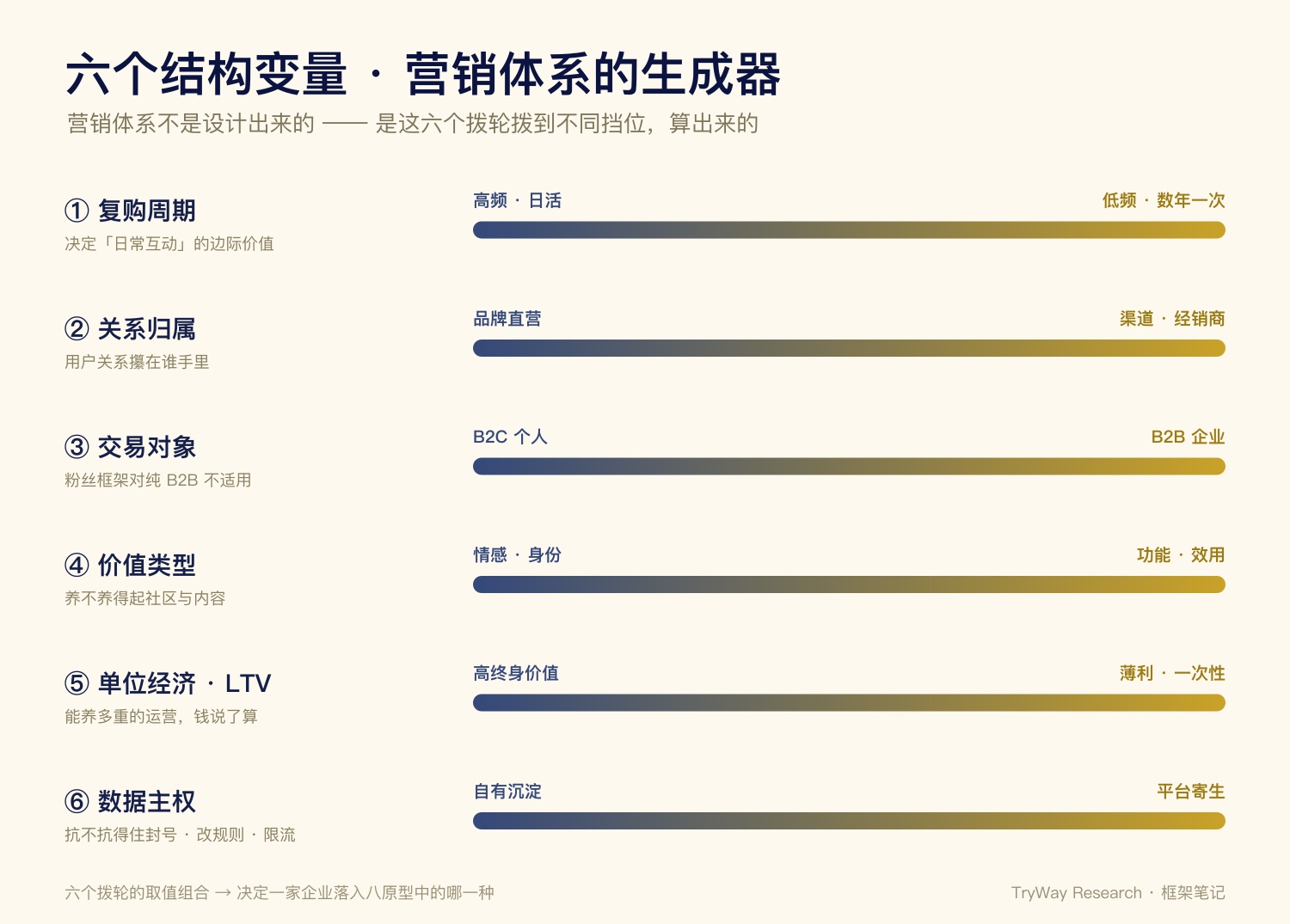
| # | Variable | Poles | What It Determines |
|---|---|---|---|
| 01 | Repurchase Cycle | High-frequency · daily-active ↔ Low-frequency · once every few years | The marginal value of "daily interaction." A car is bought once every 5–10 years and inherently needs no daily activity; FMCG/entertainment must drive repurchase through retention. |
| 02 | Relationship Ownership | Brand-direct ↔ Channel/dealer | Whose hands the customer relationship is held in. An automaker's CRM sits with the dealers, while the OEM tends only to the brand — this isn't a dereliction, it's structure. |
| 03 | Transaction Counterparty | B2C individuals ↔ B2B enterprises | The "fan operations" framework simply doesn't apply to pure B2B. When the customer is an enterprise, the play is ABM + sales, not saturating the feed. |
| 04 | Value Type | Emotion · identity ↔ Function · utility | Only the emotional kind can sustain a community and cultural capital; for the purely utilitarian kind, piling on content is a waste — users just want "it works, and it's cheap." |
| 05 | Unit Economics · LTV | High lifetime value ↔ Thin-margin · one-off | "How heavy an operation you can afford." Whether you can sustain your own app or can only skim a one-time harvest from platform traffic is a matter the money decides. |
| 06 | Data Sovereignty | Owned accumulation ↔ Platform-dependent | The most strategic dimension of all. Whether the data lives in your own database or in the platform's hands directly determines whether you can withstand account bans, rule changes, and throttling. |
II. Eight Archetypes · Four Meta-Families
Dial the six variables to representative combinations, and the customer operations of companies worldwide converge into these eight. Grouped in pairs into four meta-families — these are not developmental stages, but parallel species.
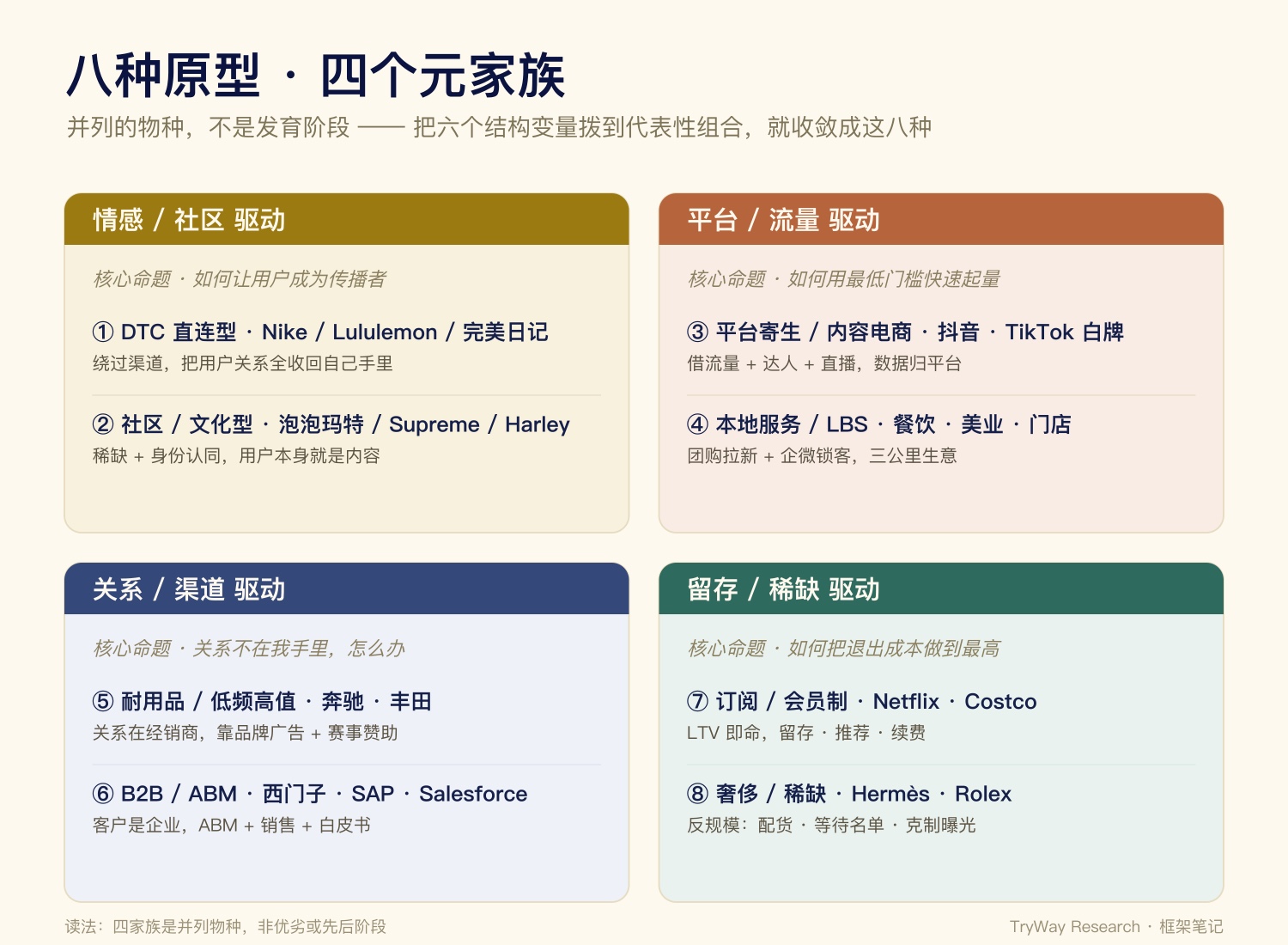
Meta-Family One · Emotion / Community-Driven
① The DTC Direct-Connect Type
Representatives: Nike · Lululemon · Perfect Diary · Warby Parker
- Logic: bypass the channel to reach consumers directly, pulling both the transaction and the relationship back into your own hands.
- Marketing core: content + community + member private-domain repurchase, with first-party data driving personalization at scale.
- Infrastructure: an owned app / CDP / unified membership account (e.g., Nike Membership connecting every channel).
- SMB replicability: Medium (SaaS can be pieced together, but an in-house app is unaffordable).
② The Community / Culture Type
Representatives: SNKRS · Pop Mart · Supreme · Harley (the H.O.G. owners club) · Lego
- Logic: scarcity + identity, where the users themselves are the propagators and content producers.
- Marketing core: drop rituals / in-group operations / UGC, manufacturing a sense of "I belong here."
- Infrastructure: a community platform + scarcity mechanics (raffles, limited editions, owners clubs).
- SMB replicability: Low (cultural capital is hard to manufacture).
Meta-Family Two · Platform / Traffic-Driven
③ The Platform-Parasite / Content-Commerce Type
Representatives: TikTok/Douyin storefront white-labels · influencer matrices · a vast crowd of small-to-mid upstarts
- Logic: borrow platform traffic + influencer seeding + livestreaming — the lowest barrier and the fastest ramp.
- Marketing core: content placement / influencer matrices / ROI arithmetic — whoever has the better hook wins.
- Infrastructure: the platform's built-in tools, plug-and-play — the price being that all the data stays in the platform's hands.
- SMB replicability: High (the lowest barrier, but the data isn't yours).
④ The Local-Service / LBS Type
Representatives: Restaurants · beauty services · gyms · neighborhood storefronts
- Logic: high-frequency + local + repurchase coupons — a business within a three-kilometer radius.
- Marketing core: group-buy (Meituan/Dianping) for acquisition + WeCom private-domain retention + word of mouth.
- Infrastructure: off-the-shelf SaaS + Enterprise WeChat, with virtually zero technical barrier.
- SMB replicability: High.
Meta-Family Three · Relationship / Channel-Driven
⑤ The Durable-Goods / Low-Frequency-High-Value Type
Representatives: Mercedes · Toyota · Mazda · major home appliances
- Logic: bought once every 5–10 years, with the relationship sitting at the dealer and the OEM holding only the brand asset.
- Marketing core: brand advertising + event sponsorship (Audi entering F1 in person in 2026) in place of daily interaction.
- Infrastructure: dealer DMS / Salesforce Automotive Cloud — a two-tier division of labor.
- SMB replicability: Low (capital-intensive).
⑥ The B2B / ABM Type
Representatives: Siemens · SAP · Salesforce · industrial goods
- Logic: the customer is an enterprise — few and heavy — with a sales cycle measured in months/quarters. There are no "fans."
- Marketing core: ABM precision targeting + sales-driven motion + white papers/case studies/industry trade shows.
- Infrastructure: CRM + marketing automation (HubSpot/Marketo) — the lead → opportunity funnel.
- SMB replicability: Medium (lightweight ABM is doable).
Meta-Family Four · Retention / Scarcity-Driven
⑦ The Subscription / Membership Type
Representatives: Netflix · Spotify · Amazon Prime · Costco
- Logic: LTV is everything, retention is life itself, and churn is enemy number one.
- Marketing core: recommendation algorithms / renewal operations / locking in membership benefits — driving the cost of exit as high as possible.
- Infrastructure: a recommendation engine + churn-prediction models + end-to-end usage instrumentation.
- SMB replicability: Medium (subscriptions gone SaaS).
⑧ The Luxury / Scarcity Type
Representatives: Hermès · Louis Vuitton · Rolex
- Logic: anti-scale. It deliberately does not run democratized digital marketing — the moment anyone can have it, it's worthless.
- Marketing core: allocation quotas / waiting lists / in-store experience / restrained exposure — scarcity is the marketing.
- Infrastructure: physical stores + scarcity management, with digitization kept deliberately "underdeveloped."
- SMB replicability: Low (anti-scale logic).
III. SMBs vs. Big Brands
Within the same archetype, the play forks by scale — and the difference comes almost entirely from "can you build your own infrastructure" and "can you afford to burn a brand budget."
| Dimension | SMBs | Big Brands |
|---|---|---|
| Infrastructure | Rent off-the-shelf SaaS and piece it together, plug-and-play | Build their own CDP / owned app / data middle-platform |
| Platform Relationship | Parasitic on the platform ecosystem — the only source of acquisition | Leverage platforms as merely one of many acquisition entrances |
| Controllable Assets | The private domain is the only thing they can grip | First-party data turned into an asset, connected across touchpoints |
| Budget Logic | Can only do performance + repurchase; brand advertising is unaffordable | Brand advertising + performance advertising running in parallel |
| Data Sovereignty | Mostly in the platform's hands, rising and falling with the platform's rules | Actively accumulated, hedging against platform risk |
| Human Leverage | Founder IP + a small team doing it all hands-on | Organized structure + agencies + middle-platform coordination |
IV. Five Global Trends
Top brands "appear" not to do fan operations because the part that actually spends the money has migrated to the invisible back end. These five are the shared direction of movement.
- Traffic buying → User assets. New privacy regulations + the long-run tightening of third-party cookies are forcing everyone to shift from "buying a one-time impression" to "accumulating first-party data." Data has become something that belongs on the balance sheet.
- Public social media → Private domain + owned app. Pulling the customer relationship out of the platform's hands and back into your own database. Social media degrades into an acquisition entrance, while daily operations happen inside the app / WeCom / email lists.
- Coarse-grained → Compliance reshaping the playbook. GDPR / CCPA / the Personal Information Protection Law have turned "consent management" into a hard constraint. Not a restriction but a new set of game rules — done well, compliance actually becomes a moat.
- Manual operations → AI reconstruction. Personalized recommendations, AI customer service, bulk content generation, churn prediction — the marginal cost of operations gets flattened by AI, and for the first time a small team can reach the fineness of a big brand.
- Platform dependence → Owned accumulation as a hedge. Account bans, throttling, rule changes, rising commissions — platform risk pushes every serious player to build up a set of customer relationships that "the platform can't take away." This one is especially deadly for content going overseas.
How to Read This (An Honest Disclosure)
This is an analytical framework, not a data report.
- The six-variable model and four-family taxonomy are a synthesized deduction
[INFERRED · MED]. - The specific brand readings (Nike's owned app, Harley's owners club, Hermès allocation, Audi entering F1 in 2026, etc.) are publicly acknowledged industry consensus
[COMMON / KNOWN]. - The piece deliberately withholds specific revenue/percentage figures to avoid fabrication.
- The "phase-out of third-party cookies" in Trend 01 has been repeatedly postponed in reality — take the direction of "shifting to first-party data" as the anchor, not a fixed timeline
[direction certain · timeline uncertain]. - Brands serve only as illustrations of archetypes, not as investment or business advice.