


A Misjudgment That Keeps Getting Conflated
First, pry apart two questions that are usually mashed together:
- Can it form a community? —— It essentially already has, and it is one of the strongest identity communities of the digital age.
- Can it become a "community/culture" commercial archetype? —— Structurally, no.
Most people intuitively leap from the first to the second: if the Bitcoin community is this cohesive, this tribe-like, then surely it can operate the way Supreme or Pop Mart does? The answer is that it cannot—and the reason it cannot is precisely what reveals the boundary of the community/culture archetype.
The community/culture type (Supreme, Pop Mart, Harley's H.O.G., Lego) is a commercial archetype, and it monetizes on two pillars: a subject owns the brand, and it manufactures scarcity of access. Put an ideological community on the stand and pressure-test it line by line: the first few rows are absurdly strong, while the last two collapse outright.
The Five-Factor Pressure Test
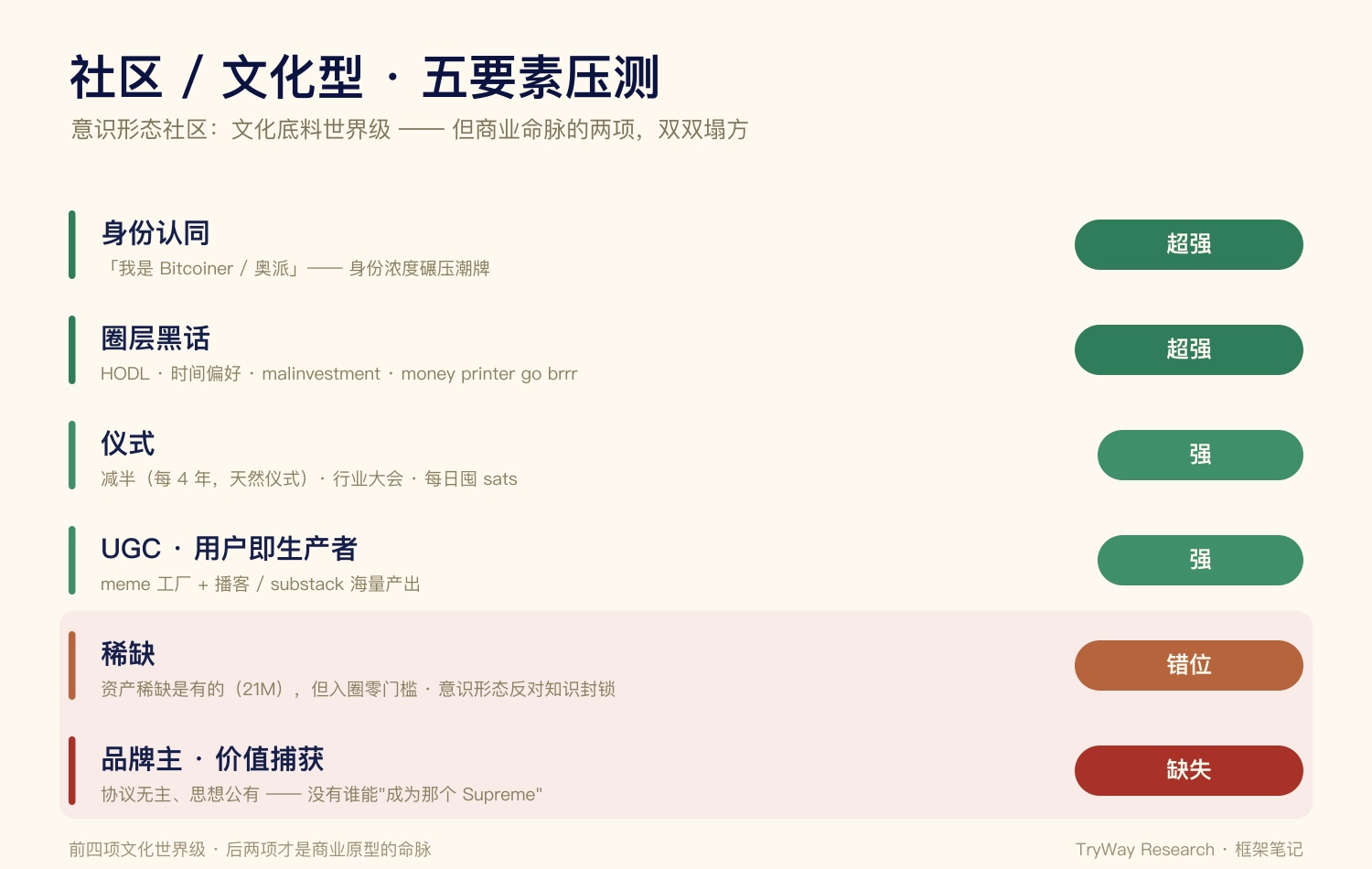
| Factor | How the commercial exemplar does it | Current state of Austrian + BTC/ETH | Fit |
|---|---|---|---|
| Identity | "I'm a Harley rider" | "I'm a Bitcoiner / Austrian / libertarian"—an intensely strong self-definition | Very strong |
| In-group lingo | Streetwear code words, inside jokes | HODL, time preference, malinvestment, "money printer go brrr" (the memeification of Austrian inflation theory) | Very strong |
| Ritual | Sneaker drops, motorcycle rallies | Halving (every 4 years, a native ritual), industry conferences, the daily "stacking sats" | Strong (BTC) |
| UGC / users as producers | Fan reinterpretations | Meme factory + a torrent of podcasts / Substacks | Strong |
| Scarcity | Supreme drops, limited allocations | Asset scarcity (21M cap) is the core of the narrative ✅; but entry / content is zero-barrier, and the ideology opposes knowledge lockup ❌ | Mismatched |
| Brand owner / value capture | Supreme = owned and monetized by LVMH | The protocol is ownerless, the ideas are public property, no entity can "become that brand" | Absent |
For the first four rows, the intensity of the Bitcoin and Austrian communities crushes most commercial brands—the identity density of "I'm a Bitcoiner" far exceeds "I buy Nike." But the community/culture type is a commercial archetype, and its lifeblood lies in the last two rows—which are exactly the ones that cave in.
Insight One · "Ownerless" Is a Structure, Not a Defect
Supreme's model works on one premise: there is a subject (the parent company, LVMH) that owns the brand and monetizes attention through limited releases. Bitcoin has no CEO, no marketing department, no one who can "throw a drop"; the Austrian School is a body of public thought with no owner.
This is not "hasn't yet learned to commercialize"—it is the very definition of decentralization. A genuinely ownerless protocol / school of thought inherently lacks the subject that could fence the community in and charge admission. So the community/culture hat, however thick the culture, simply cannot be worn—there is no "who" to go and play the Supreme.
Insight Two · Free Is Precisely the Right Play for an Ideology
Here lies a cross-category error.
The Mises Institute gives away the full text of Human Action, and opens thousands of articles and lectures for free. Through Supreme's eyes, this is "utterly failing to manufacture scarcity." But it is exactly the correct strategy for an ideology: ideas win hearts by spreading for free. Free content is evangelism, not a business left on the table.
So the true benchmark is not luxury brands, but the church + open-source community:
- Scripture: Human Action, The Bitcoin Standard
- Preaching (free content): no walls, the more who read it the better
- Patronage: surviving on believers / donations / sponsorship, not on selling scarcity
Cramming Austrian economics or Bitcoin into "scarcity-driven" is applying a luxury-goods model to a religious movement—the direction is exactly reversed. Scarcity sells "you can't have it"; evangelism sells "everyone should have it."
Insight Three · Core Consistency Decides Whether a Combination Works
The premise "BTC + ETH community" itself is unstable, with two fault lines:
First, there is a real schism. Bitcoin maximalism has long looked down on Ethereum, faulting it as insufficiently decentralized and closer to a security. Treating BTC and ETH as one unified community ignores this tribal fault line to begin with.
Second, Austrian economics is a match made in heaven with BTC, and a marriage of convenience with ETH. Bitcoin's fixed supply = the "sound money" ideal of Mises / Rothbard, a perfect core alignment; Ethereum's monetary policy is adjustable (PoS issuance, EIP-1559 burn), which to hardcore Austrians looks closer to "central-bank-style planning." The cultural core of the ETH community is builders / DeFi, not sound money.
Conclusion: a community's cohesion depends on the consistency of its core narrative. "Austrian + BTC" is one narrative (sound money vs. fiat debasement)—sharp, self-contained; "Austrian + ETH" is a forced fit that contradicts itself on the philosophy of money. To build a community, first ask whether the core is the same story.
The Realistic Path · A "Ring of Commercial Nodes" Atop an Ownerless Movement
So what can it realistically grow into? Not "a Supreme," but a ring of owned commercial nodes growing atop an ownerless movement—each node monetizing by applying a different archetype. The movement itself doesn't charge; the nodes do.
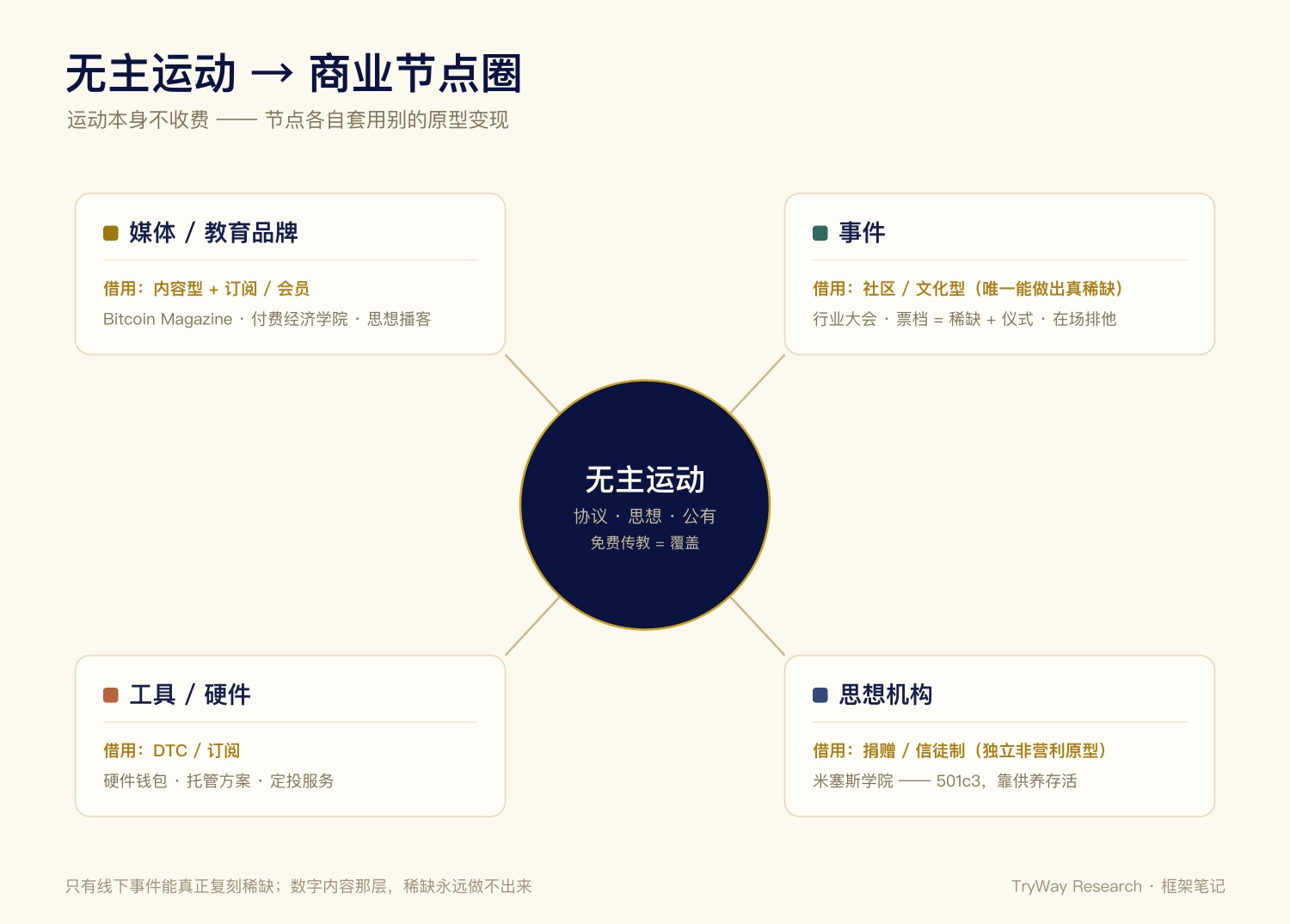
| Node type | Example | Borrowed archetype |
|---|---|---|
| Media / education brand | Bitcoin Magazine, The Bitcoin Standard + paid economics academies, ideas-driven podcasts | Content type + subscription / membership type |
| Events | Industry conferences (ticket tiers = scarcity + ritual; real scarcity only happens offline) | Community / culture type (the small piece of it that can actually land) |
| Tools / hardware | Hardware wallets, custody solutions, DCA services | DTC / subscription |
| Think tanks | The Mises Institute itself | Donation / believer model (a standalone nonprofit archetype) |
Note: only offline events can truly reproduce the scarcity of the community/culture type (tickets are finite, presence is exclusive). At the layer of digital content, scarcity can never be manufactured—which is exactly why conference tickets can sell for money while articles can only be free.
Methodological Wrap-Up
The value of this case extends beyond crypto itself. It yields a transferable judgment:
An ideological community is a standalone archetype—it does not belong to the community/culture type (no subject, anti-scarcity), and is closer to "movement / church / open source." Its growth formula is free content for reach (evangelism) + paid membership / products / donations for revenue (freemium / patronage), never a luxury-style wall of scarcity.
Any values-driven, subject-less movement follows the same logic—open-source software, religion, fan bases around public-domain works, all of them. To do business inside such a movement, don't try to own the movement (it's ownerless; you can't hold it), but build a node that serves the movement: use evangelism to reach people, use the product layer to collect money. The fate of the wrong model is this—you neither spread the faith nor turn a profit.
A Note on How to Read This (Honest Labeling)
This is an analytical framework, not an investment or political judgment.
- Structural judgments about identity / scarcity / ownerlessness are framework inference
[INFERRED · MED-HIGH]. - Specific cultural facts (the 21M cap, the halving cycle, the "money printer go brrr" meme, the tension between maximalism and ETH, The Bitcoin Standard explaining Bitcoin through an Austrian frame) are public consensus
[COMMON / KNOWN]. - The whole piece contains no price predictions and no specific financial figures; brands / protocols serve only as archetype illustrations.
- "Church / open source" is an explanatory analogy
[FRAME], used to convey strategic direction, not equivalent to a claim about reality.