


A few days ago I read an article that dissected the AI relay-station business from top to bottom—the profits, the setup, the inside baseball—written in considerable detail. The author spent half a month laying bare the muscle beneath the skin of this industry. (Source: Ai Shu ArtPivot, Nixiang AIGC, April 25, 2026.)
After finishing it, I felt one thing had gone unsaid—or rather, said too lightly.
That is: what the real risk of this business actually looks like.
Hidden in Plain Sight
First, let me grant that this market genuinely exists.
Search "claude relay" on Xianyu and you get a full screen of results, single listings selling upward of four thousand orders. Search "api relay station" on Taobao and you find, all told, a dozen-odd shops, with prices, tiers, and packages spelled out plainly—sold like any standardized product. Half the posts on Xiaohongshu teach you how to build one; the other half curse whichever operator just ran off with the money. On V2EX's developer community, almost every week someone posts that they've joined a new relay, half price during the beta period.
This is not an underground trade. This is business conducted in the open.
The logic behind it isn't complicated. The APIs of OpenAI and Anthropic can't be used in China—not for technical reasons, but because of payment and networking. Without an American credit card, you can't get past the top-up; without a clean IP, your account gets flagged by risk controls at any moment. So someone bridges these two barriers, wraps a shell around them, and resells to the outside. The interface is identical to the official one, and the price can drop to thirty to fifty percent of official rates. That's a relay station.
There are studios with account pools of 100 to 500, monthly turnover of fifty thousand to three hundred thousand yuan, and net profit of ten thousand to eighty thousand. The original article mentioned a friend who'd been at it for two years: an account pool of 200, a team of just himself plus one part-time customer-service worker, netting thirty to fifty thousand a month.
Frankly, that's no small number.
Betting One to Win Ten
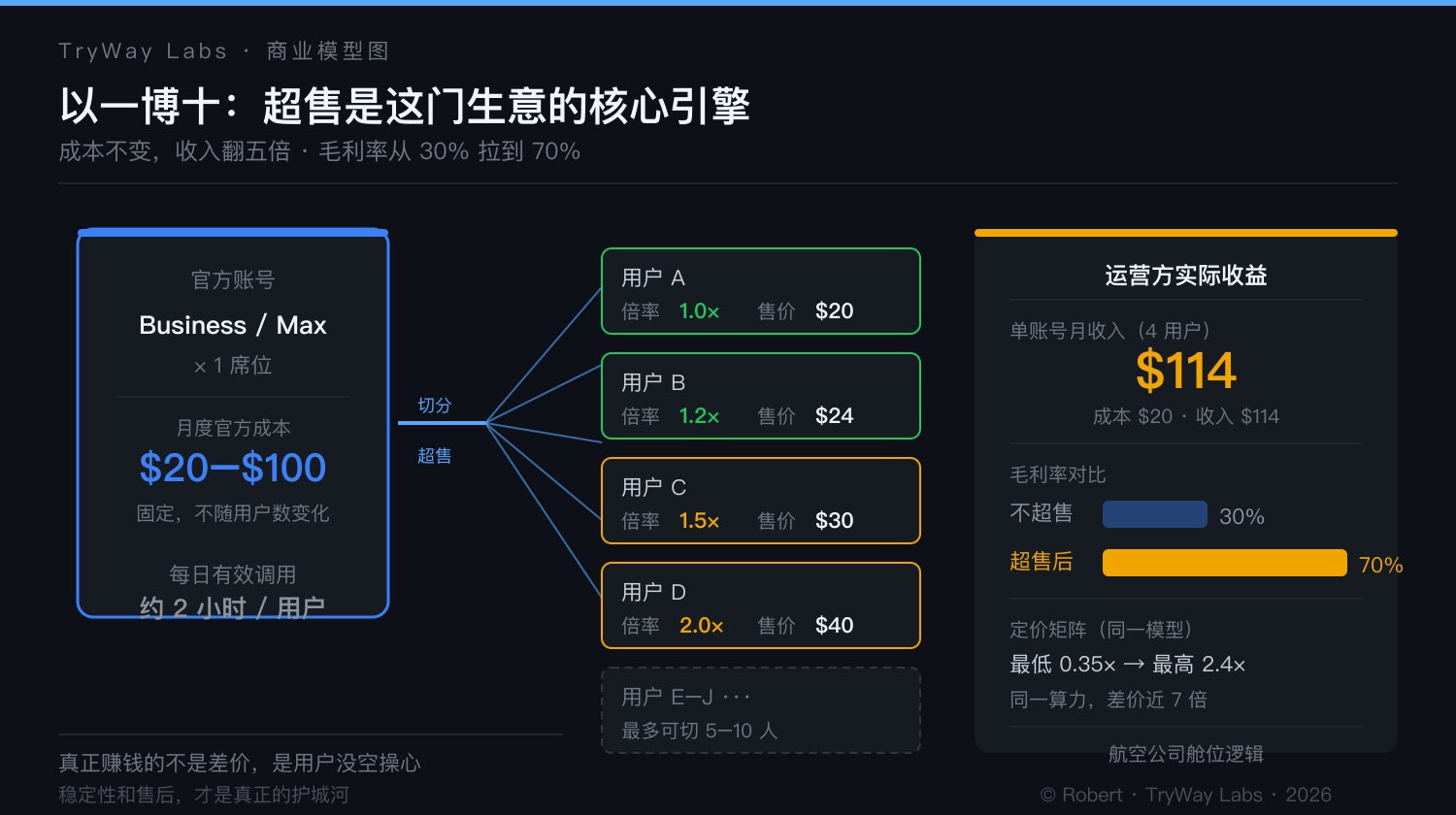
The real profit point is overselling.
Official Business accounts are billed by seat—one seat, one user. But most users spend no more than two hours a day calling the API, leaving vast stretches of idle time in between. The operator splits a single account among five to ten users to share, and once load-scheduling is done well, users don't perceive the conflict. Cost stays the same, revenue multiplies fivefold, and gross margin jumps from 30% straight to 70%.
This is why some dare to offer thirty-percent-off pricing—they're packing several of you into the same account.
The profit structure of a mixed API is even more finely tuned. The same model ID can hang five to seven price points across different groupings, from a low of 0.35x to a high of 2.4x—a spread of nearly seven times. It's airline cabin-class logic: slice the same slab of compute into different SKUs and sell them to people of differing willingness to pay. Some platforms even peg pricing to the time of day—calls made during the US West small hours are cheap, while the evening peak is billed at double.
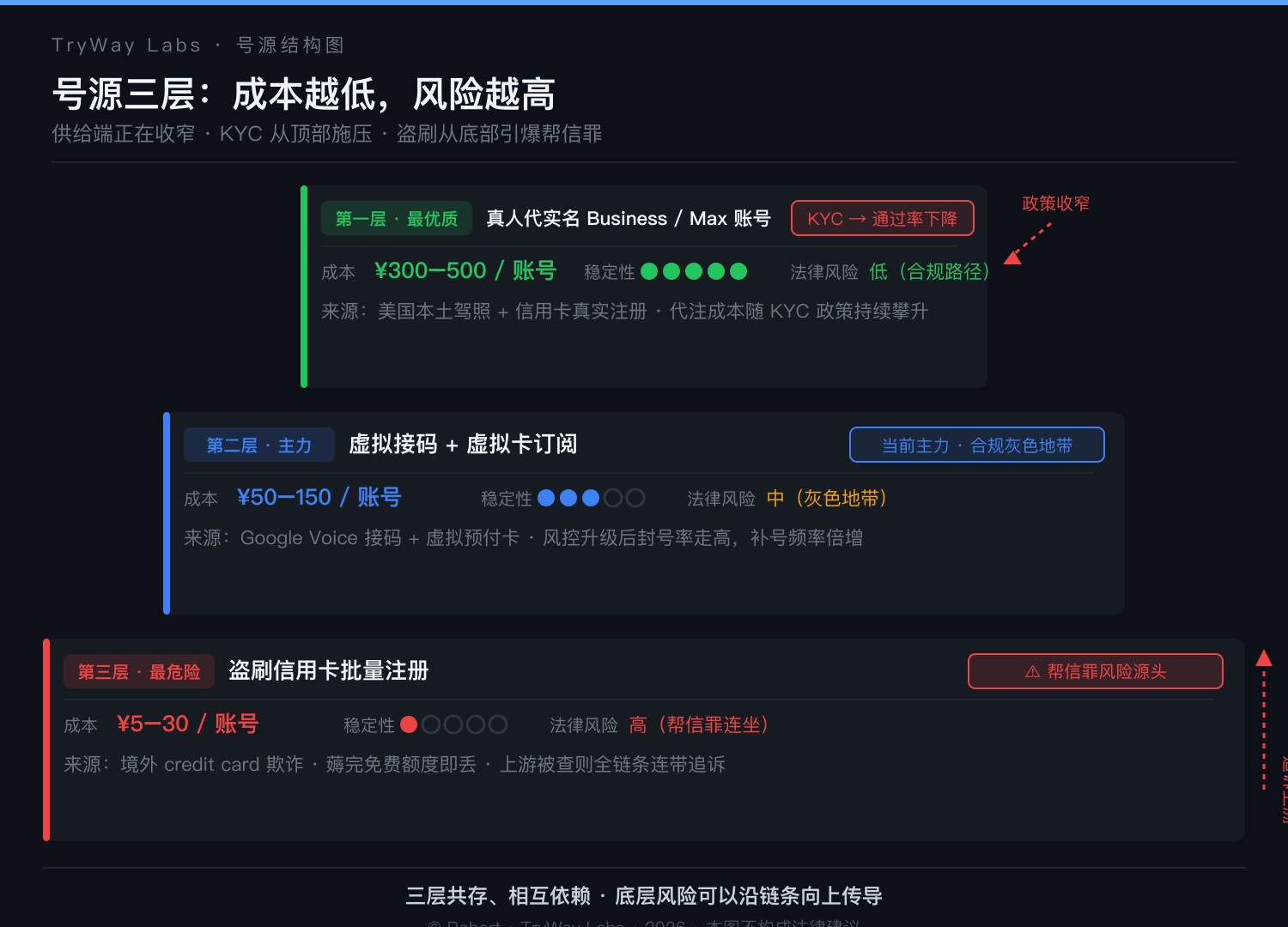
The upstream-to-downstream chain is long: upstream are the card vendors, account vendors, and IP proxies; in the middle sits the relay station proper; downstream are the Claude Code developers and secondary distributors. The account supply—that is, where the accounts come from—splits into three tiers. Cheapest are the junk accounts registered in bulk with stolen credit cards, discarded once their few dozen dollars of free credit is skimmed; the middle tier is virtual phone numbers plus SMS-verification codes and virtual-card subscriptions; the priciest are the Business/Max accounts registered under a real person's identity by an American local on your behalf—only these can sustain a stable account pool.
The original author said it too: accounts under 100 yuan are basically junk that's been laundered a few rounds—load three hundred dollars and the account is gone the next day.
Pulling the Firewood from Under the Cauldron
Just ten days before the original article went out, Anthropic announced it was enabling identity verification (KYC) for some users, handled by the third-party service Persona—a passport or driver's license, plus a facial selfie. This isn't blanket enforcement, but a selective trigger targeting specific usage scenarios and platform-integrity checks.
But taken together, the impact of this is structural.
Mainland China was never on Anthropic's list of supported regions to begin with, and in September 2025 Anthropic specifically tightened the ban once more—prohibiting Chinese-controlled companies from using Claude worldwide. The gap on the account-supply end is narrowing layer by layer; it wasn't sealed shut all at once on some single day. Business/Max accounts registered under a real person's identity were already expensive, and selective KYC drives pass rates down further. Meanwhile, from July to December 2025 Anthropic had already banned 1.45 million accounts, and in January 2026 the refund policy shifted from "ban and refund" to "ban, no refund."
Before Anthropic began its "selective KYC," the supply side of this business was already contracting. KYC simply sped that up.
Which means: the window of time to get in is narrowing—but the people selling you this business won't tell you that.
The Precedent Is Already Set
This is the part I actually wanted to write today.
The original article closed with a line: "On the compliance front, reselling APIs is prohibited under Anthropic's ToS, but domestic law has no corresponding provision—what you bear is account bans and payment freezes, not personal risk."
That line struck me as off.
It is a fact that Chinese law has no corresponding provision reading "thou shalt not resell AI accounts." But that does not mean there is no legal exposure—because a conviction doesn't require an exact match to a provision, only that the nearest frame be found.
First, the hard evidence, and it's recent.
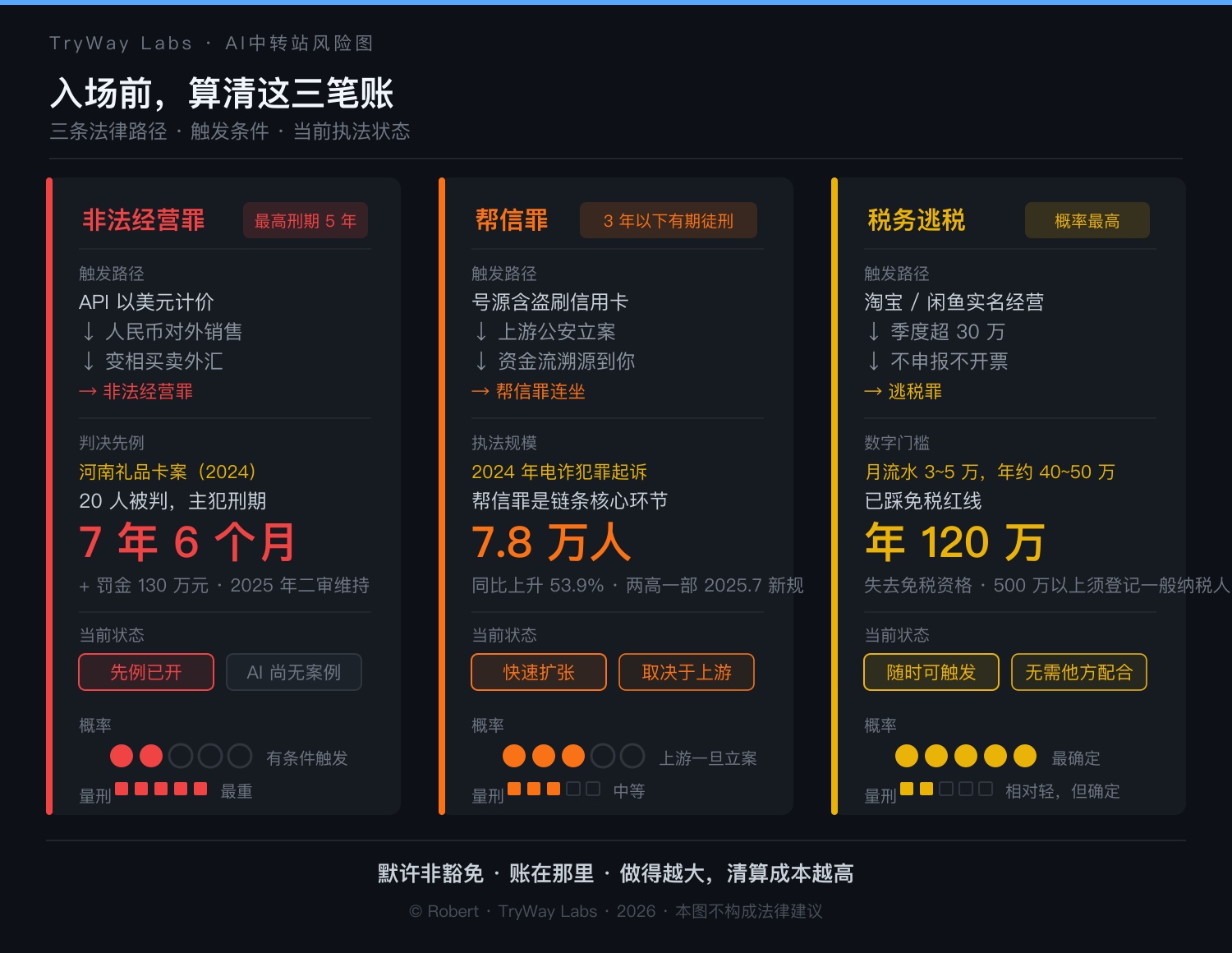
In September 2024, the procuratorate of Xinmi, Henan Province, indicted a criminal ring of twenty. What they did was this: use WhatsApp to find overseas gift-card holders, buy the cards at below the naira exchange rate, then sell them to domestic buyers at below the dollar exchange rate, profiting off the spread. Two companies, illegal revenue totaling 63.3 million yuan.
In December 2024, the Xinmi court handed down its first-instance verdict: twenty defendants, the ringleader sentenced to seven years and six months' imprisonment and a fine of 1.3 million yuan. The other defendants received terms ranging from two years to five years and six months, each with a fine.
In February 2025, the Zhengzhou Intermediate People's Court rejected the appeal on second instance and upheld the original verdict.
The charge: illegal business operation.
The legal frame runs like this: overseas gift cards are denominated in dollars, so buying and selling them substantively effects a cross-border exchange between renminbi and foreign currency—it amounts to "disguised trading in foreign exchange," in violation of the Regulations on Foreign Exchange Administration, and constitutes the crime of illegal business operation.
Now look back at the AI relay station. Official API credit is denominated in dollars ($5, $20, $60, and so on), and the operator sells the equivalent service to Chinese users in renminbi—which, at bottom, is also this: buying dollar-denominated compute credit with RMB.
To be clear, the gift-card case is closer to a two-way currency exchange, and the AI relay station's service nature differs from it. But the extensibility of the legal frame is real, and the interpretive opening the gift-card case pried open could, in theory, extend to any model in which "a dollar-denominated virtual good is transacted through renminbi." There is as yet no sentencing precedent for AI relays—but that doesn't mean "it doesn't apply," only that "no one has prosecuted one yet."
Next, the expansion of the aiding-cyber-crime charge.
The crime of aiding information-network criminal activity, colloquially the aiding-cyber-crime charge. The logic is simple: knowing that the upstream party may be engaged in unlawful conduct, and still providing technical support, payment settlement, or account resources, where the circumstances are serious, is punishable by up to three years' imprisonment.
In 2024, procuratorates nationwide indicted 78,000 people for telecom-network fraud crimes, up 53.9% year over year. The aiding-cyber-crime charge is a key link in the telecom-fraud chain; providing accounts, payments, or technical support to it all falls within the scope of prosecution.
This is not an obscure charge—it is a rapidly expanding enforcement tool. A considerable share of AI relay stations' account supply comes from bulk registration with stolen credit cards. Once the police open a case upstream, they follow the money flow of the credit-card fraud downward—first the account vendors, then the relay-station operators. Knowingly participating in the business while the account provenance is dubious: the aiding-cyber-crime frame is right there.
Finally, taxes.
This is the highest-probability path, and the one most easily overlooked.
Taobao and Xianyu are real-name systems, with complete transaction records. Small-scale taxpayers with quarterly sales above 300,000 yuan (equivalent to 1.2 million a year) lose their tax-exempt status; anyone with annual sales above 5 million must register as a general taxpayer and issue invoices and pay tax at a rate of 13% or 6%. A relay station pulling in thirty to fifty thousand a month, four to five hundred thousand in annual turnover, has already crossed the line; seven or eight hundred thousand forfeits the exemption entirely. Not filing, not invoicing—that is tax evasion. The tax authority needs no cooperation from the police, no complaint from an overseas company; it can pull the data, issue a notice, and open a case all on its own. The bigger you grow, the clearer your books—and the higher the cost when the reckoning comes.
The original author wrote that "at the ten-million-a-year turnover level, taxes suddenly become an enormous problem"—when in fact, a few hundred thousand has already crossed the tax-exempt line.
Tolerance Is Not Immunity
Relay stations aren't underground—they're all out in the open, for four reasons: one, the aggrieved parties are overseas companies (Anthropic, OpenAI), with little incentive to file a report in China; two, the victims of the upstream credit-card fraud are also overseas, so domestic police face no pressure to open a case on their own initiative; three, individual case amounts are scattered, making it poor cost-efficiency for the police; four, in practice it satisfies domestic developers' demand, giving local regulators a motive to look the other way.
But all four are conditions of the present moment, not structural guarantees. The platform data is always there, the historical record is always there, traceable at any time. The greatest risk in this line isn't getting caught today—it's that the longer and bigger you run it, the more the cost of the reckoning rises exponentially.
What's more, every line of your code, every stretch of conversation, every business question, sets out from your computer, has to pass through the relay party's server, and only then reaches the model. That middle stop can look if it wants to, and store if it wants to. The original article closed with this line, and I think it's the most honest sentence in the whole piece.
Deliberate, Then Act
This article is neither telling you to stay out nor telling you it's safe to jump in.
What TryWay Labs talks about has never been "what you should do," but "before you make the decision, here are a few things you should be clear on."
This business really is solving a real problem—Chinese developers can't get the best AI tools, and someone has built a bridge at their own risk. Even if the motive is money, it's still transfusing blood into the whole ecosystem. That value is real.
But value is not a margin of safety.
Those twenty people in the gift-card case probably also felt, right up until the verdict landed, that they were merely earning an exchange-rate spread.
Enter if you will—but tally the accounts first.
References:
- Ai Shu ArtPivot, "I Spent Half a Month Dissecting the AI Relay-Station Business from Top to Bottom," Nixiang AIGC, April 25, 2026
- Henan Provincial People's Procuratorate · Yujian Stories, "The Little Gift Card: Why It's Tied to the Crime of Trading Foreign Exchange," May 2025
- Supreme People's Procuratorate, "In 2024, Procuratorial Organs Indicted 78,000 People for Telecom-Network Fraud, Up 53.9% Year over Year," March 2025
- Two High Courts and One Ministry, "Opinions on Certain Issues Concerning the Handling of Criminal Cases of Aiding Information-Network Criminal Activity, Etc.," July 2025
- Anthropic Official Help Center, Identity verification on Claude, April 2026