


The overwhelming majority of startup advice boils down to one sentence: "Trust me, I've seen a lot." The deeper the consultant's credentials and the more certain the tone, the harder it is for you to push back—but "hard to push back" and "correct" are two different things. This mechanism carries an original sin: it ties the credibility of a judgment to a person. Change the consultant and the conclusion changes; the consultant is in a good mood today and the standard loosens.
Is there a way to tie the credibility of a judgment to rules rather than to people?
This article describes one such attempt: forging Ash Maurya's lean startup methodology into an analysis protocol that a machine can execute and whose every conclusion can be independently traced. Internally we call this engine "Lean Forge." It doesn't hand you "I think this could work"—it puts a startup idea through 11 gates, each gate interrogating it with a fixed scorecard, and every "pass / fail" verdict can be traced back to a specific line of the scorecard.
Dig deeper and you'll find it shares the same skeletal frame as something you already know—Bitcoin. We'll save that point for the end. First, let's meet the person who wrote this methodology down.
Quick overview · TL;DR · definition · FAQ
TL;DR
- Lean Forge addresses one problem: startup judgment should not depend only on consultant authority; it should be decomposed into repeatable, auditable, traceable rules.
- It pushes an idea through three stages and eleven gates: interrogate the business model, rank the riskiest assumptions, then form a validation cadence.
- AI is not used here to "guess for humans," but to execute fixed scorecards, evidence requirements, PASS / LOOP states, and output formats consistently.
- The value is not guaranteeing success, but exposing critical assumptions earlier and reducing the chance that a team spends time on the wrong problem.
Definition
Lean Forge is an auditable analysis protocol for startup ideas and new business directions. It turns lean startup, Lean Canvas, risk ranking, and validation cadence into fixed steps, allowing an AI or analyst to output judgments, evidence, scores, and next experiments under the same rules instead of issuing unreviewable subjective advice.
FAQ
How is Lean Forge different from an ordinary business consultant?
Ordinary consulting often binds judgment to personal experience. Lean Forge pushes judgment into rules, scorecards, and evidence trails. You can disagree with a score, but you can see which rule, evidence item, and assumption produced it.
Can it guarantee that a project succeeds?
No. Its purpose is not to predict the future, but to reduce self-deception: identify the riskiest assumptions earlier and force the team to test the premises that could kill the project before building attractive but unvalidated parts.
Why let AI execute this method?
AI is good at repeatedly interrogating, summarizing, scoring, comparing, and formatting under explicit rules. If the protocol is clear enough, AI can turn the method into a repeatable workflow while humans keep the right to review critical conclusions.
References and Further Reading
- Ash Maurya's Running Lean, Lean Canvas, and 90-day validation cadence.
- Eric Ries and Steve Blank's lean startup and customer development tradition.
- Bitcoin-style trustless design: moving credibility from people to rules, records, and verifiable process.
- Related TryWay topics: AI memory systems, auditable system design, and SEO/GEO content engines.
An Engineer Who Was "Fed Up With Building Things Nobody Wanted"
The methodological skeleton of Lean Forge comes from Ash Maurya's Running Lean (Running Lean). This man deserves a passage of his own, because he isn't an academic theorist—he's a doer who stepped in the potholes himself before turning around to build the tools.
| Dimension | Fact |
|---|---|
| Background | Bachelor's in electrical engineering from Rochester Institute of Technology (RIT); first worked as an engineer at a telecom technology company |
| First venture | Founded Wired Reach in 2002, building "peer-to-peer + Web" applications that fused desktop and web |
| Turning point | An epiphany in 2009—"Life's too short to build something nobody wants" |
| Lineage | Following that thought, he found the early work of Eric Ries and Steve Blank (the two founders of the lean startup movement) and made it operational on top of it |
| Signature works | The two books Running Lean and Scaling Lean; founded the LEANSTACK platform |
| Signature invention | The Lean Canvas—a reworking of Osterwalder's business model canvas into a startup version more focused on "the problem," reportedly used by over a million entrepreneurs |
| Evangelism | Runs workshops worldwide year-round, mentors at accelerators such as TechStars, and guest-lectures at MIT, Harvard, and UT Austin |
Connect these dots and you see that Maurya's contribution isn't "inventing lean startup" (that credit goes to Ries and Blank), but turning a philosophy into an operable template and cadence: the Lean Canvas gave "thinking it through" a one-page handle, and the 90-day cycle gave "validation" a fixed beat. What he did was engineering, not preaching—and this is precisely the precondition for this methodology being able to be "implemented as an engine": only a methodology that is already engineered can be disassembled into a state machine.
What the Engine Is: Three Stages, Eleven Gates, One Convergent Pipeline
Lean Forge forges an idea that is "still just an idea" into three things—we call this the convergence trio:
- A business model that has been interrogated (which parts are validated conclusions, which are still just guesses);
- A ranked list of the riskiest assumptions (which one to test first);
- The single validation experiment to run next (what to do, how to verify it, how long until you see results).
The idea enters from the left and advances in sequence through three stages—"Design → Validation → Growth"—across 11 gates in all. Clear a gate (PASS) and move to the next; get stuck (LOOP) and fall back to an earlier gate to start over. The cleverest part is the side line—you don't have to walk through all 11 gates; at any moment you can request a conclusion, and the engine emits the trio directly based on the current state.
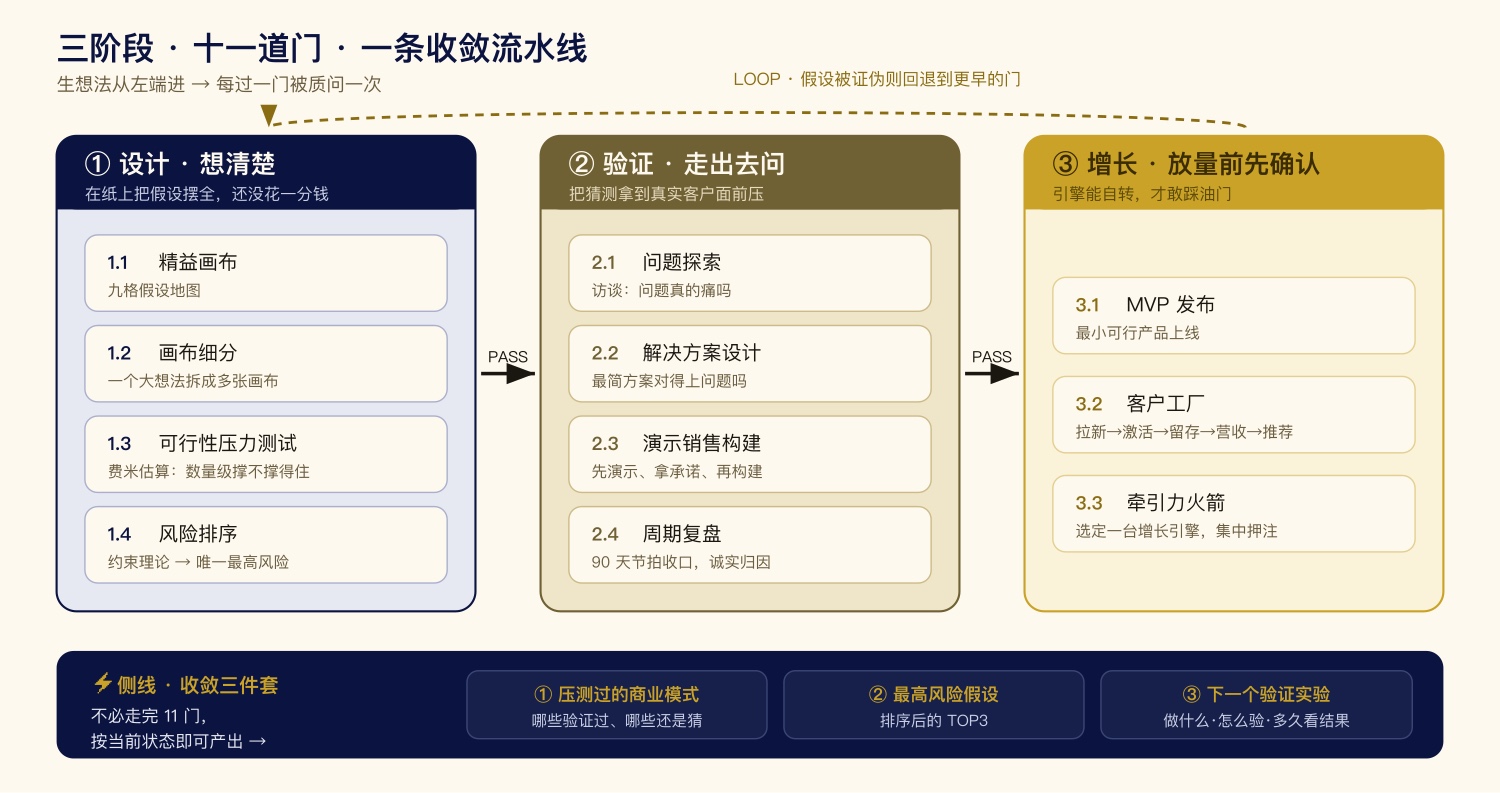
The design intent of this pipeline is clear: the design stage lays out all the assumptions on paper (before any money is spent), the validation stage goes out and asks real customers, and the growth stage confirms the engine can turn on its own before daring to hit the gas. The order can't be scrambled—think it through before validating, validate before scaling—that is lean startup's most core anti-waste discipline.
Opening Up the Machinery (I): The "Four Beats" of Each Gate
Whether an engine is durable isn't judged by what it claims, but by how it turns inside.
The 11 gates are not 11 sets of logic, but share a single analysis protocol, reading in different gate files and models only at runtime. This protocol is called the "four beats": fetch the source material → read the model → apply it to the case → score and rule.
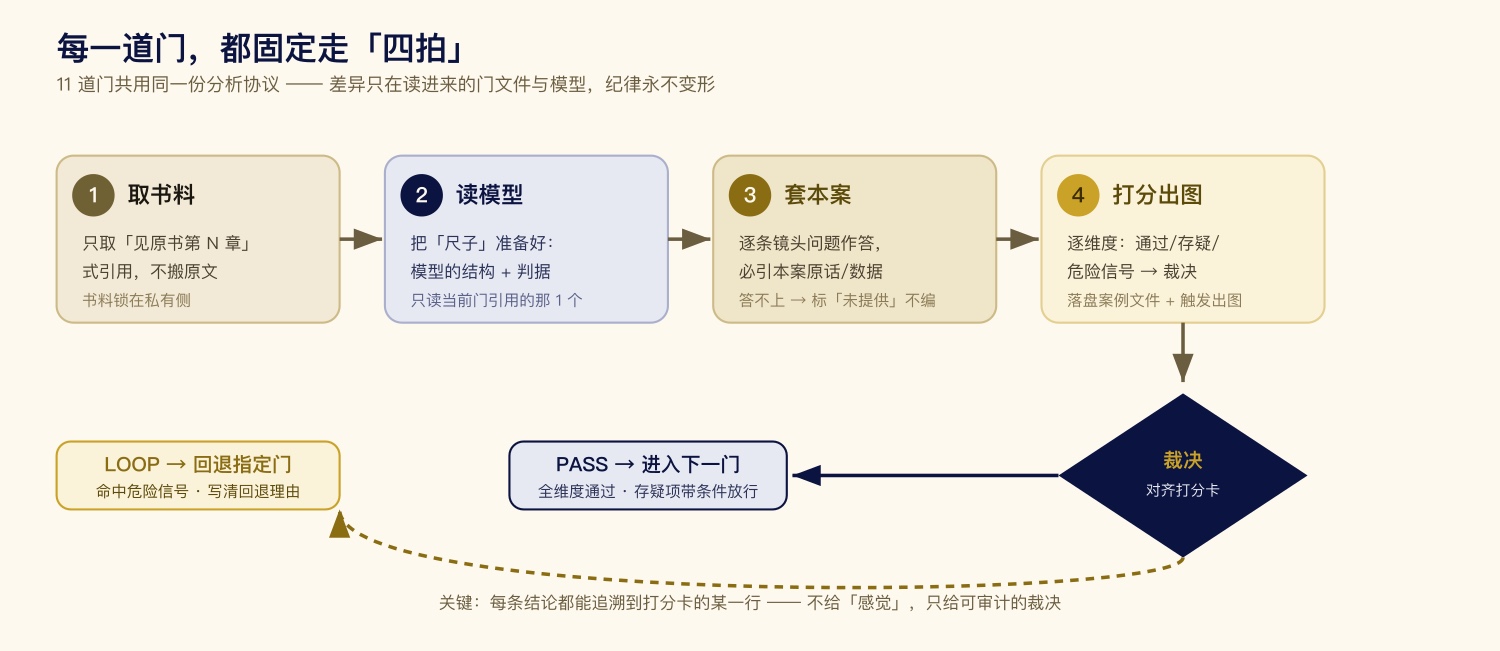
The value of this design lies in the discipline not deforming from gate to gate. No matter which gate you reach, the cadence stays the same, the output template stays the same, and the red line—"if you can't answer, mark it as not provided; never fabricate an answer for the founder"—stays the same. It compresses the soft spot of "analysis quality depends on the analyst's state" into a reusable, fixed process. And every verdict must align with a specific line of the scorecard—this is the bedrock of the whole system: it doesn't give you "a feeling," only auditable conclusions.
Opening Up the Machinery (II): Progressive Disclosure
The second piece of engineering is even smarter, and directly bears on "is this thing expensive to run." Lean Forge is pure markdown, with no resident process; it breaks the entire methodology into a pile of small files and reads them strictly on demand at runtime—whichever gate you reach, it reads only that one gate plus the one model it references, loading none of the other gates or models.
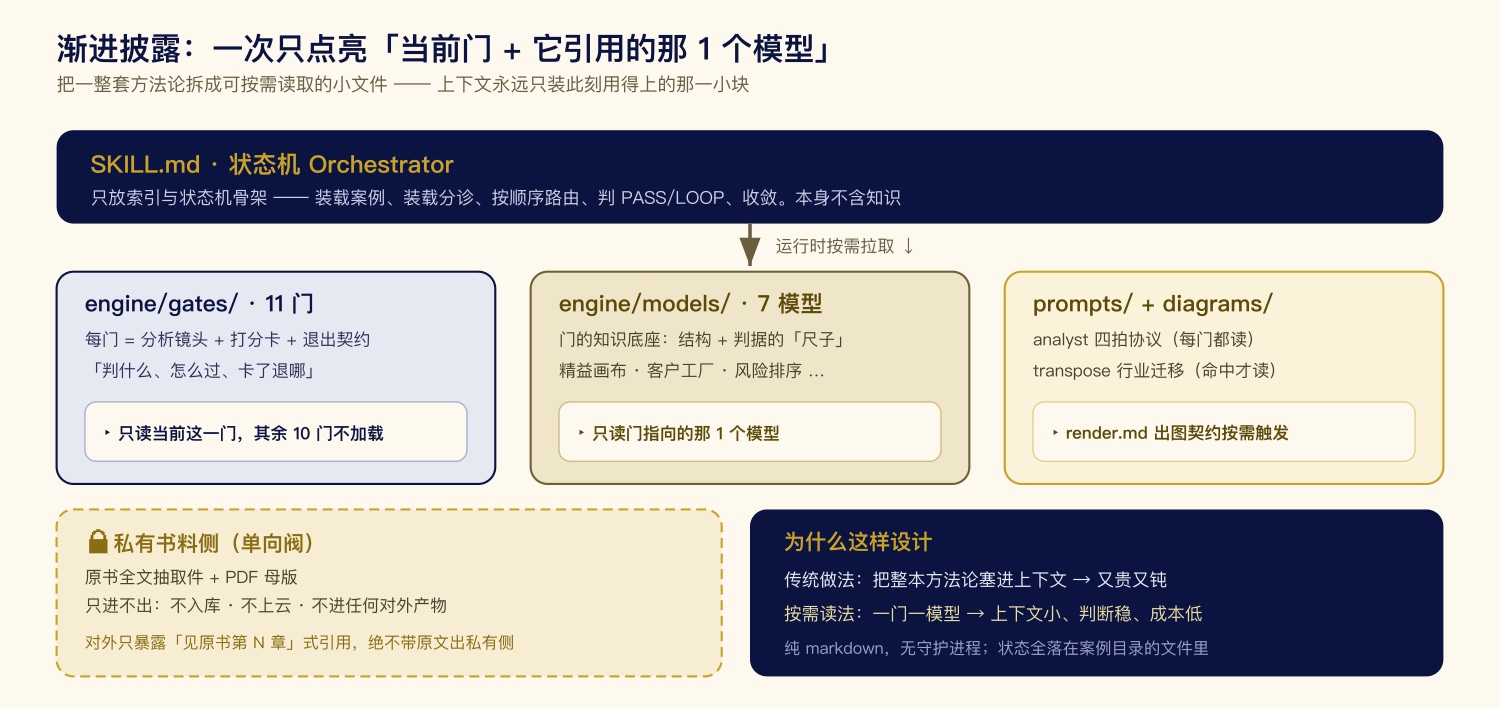
For a system running inside the context of a large model, this is the key to saving cost while preserving stability: the smaller the context, the less easily the judgment is led astray by irrelevant information, and the lower the compute cost. The traditional approach stuffs the entire methodology into the context—expensive and dull; progressive disclosure solves this cleanly with "one gate, one model." This point is pure engineering craft, unrelated to the methodology.
By the way, one easily overlooked discipline: the full text of the original book is locked on the private side, and the system references it externally only in the form "see Chapter N of the original," moving no original passages. Methods, processes, and concepts are not protected by copyright; only verbatim copying infringes—keeping this boundary clean is the precondition for tools of this kind to last.
What's Good About This Design
Read through all 11 gates, the model layer, the execution protocol, and the rendering contract, then look at what it produces on real cases, and several genuine strengths hold up:
| Strength | Why it counts as a genuine strength |
|---|---|
| Auditable judgment | Every PASS / LOOP can be traced back to a specific line of the scorecard—replacing "I think" with "which criterion did it align with." |
| Clean separation of concerns | The four layers—gates (what to judge), models (the knowledge base), protocol (how to analyze), rendering (drawing)—are decoupled and can each be read and modified independently. |
| State as file | "Which gate you've reached" isn't stored in a separate field but inferred back from the case file—no database, no state lost on a crash, resumable across sessions. |
| Anti-self-deception is the default posture | The analysis protocol explicitly states "don't loosen the standard just because the founder's tone is confident," and every scorecard carries a "danger signals" column. Gates exist to filter out self-deception, not to rubber-stamp it. |
| Convergence anytime | You don't have to finish all 11 gates to get a conclusion—fitting the real entrepreneur's impatience, which wants the judgment right now, not the ritual of running the full process. |
| Confidence propagates downward | The output is labeled cell by cell as "validated / partially validated / still a guess," carrying the difference between a rough estimate and a precise calculation all the way to the final conclusion. Honesty over good looks. |
Seeing Is Believing: The Forge's Diagnostic Album
The previous sections were all about design intent—auditable judgment, state as file, progressive disclosure saving compute. These assertions deserve a physical object to back them: exactly which diagrams can the Forge draw with its own hand? Lay them out and you'll know.
Output comes in two tracks, corresponding to different production forms across the three-stage pipeline. Track A (SVG, with template text slots injected by wrapping case data across lines) serves the design stage, producing a static judgment card that can be drawn before a case has even begun validation; Track B (draw.io skeleton copying) serves the validation and growth stages, producing the structural diagrams of process cadence after things are up and running. Both tracks share one discipline: the template itself is empty, data is read in from the case file and projected, no old diagram is cached, and the moment a case updates it can be redrawn. What's laid out below is the blank templates themselves—the five tools the engine can project data onto for any given case at any moment, involving no specific customer's data.
Track A · Two cards for the design stage
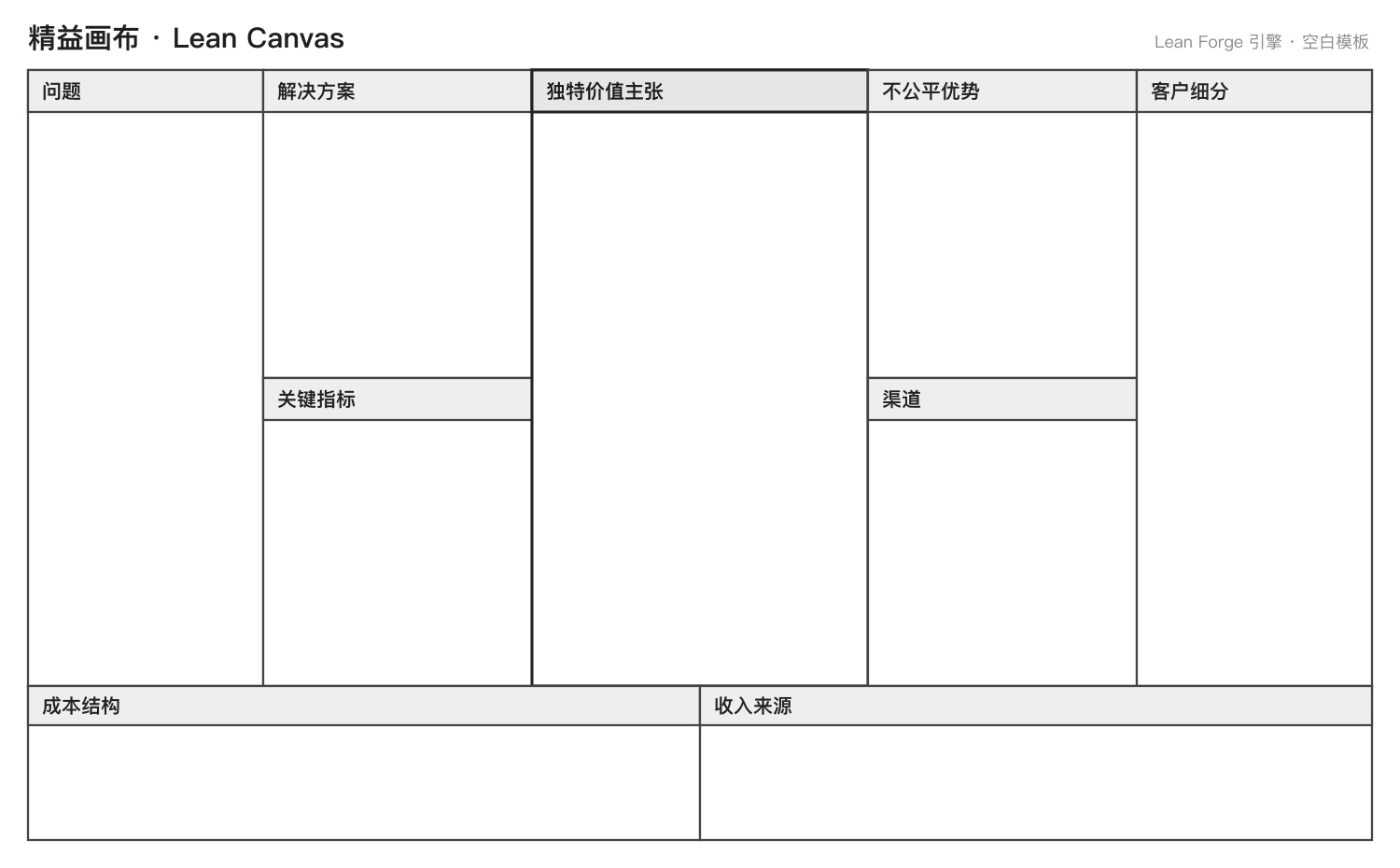
Nine cells break a business down into its nine most basic questions—from "who pays" to "where the money comes from." This card answers Gate 1.1: does the business model behind the idea in hand actually hold together?
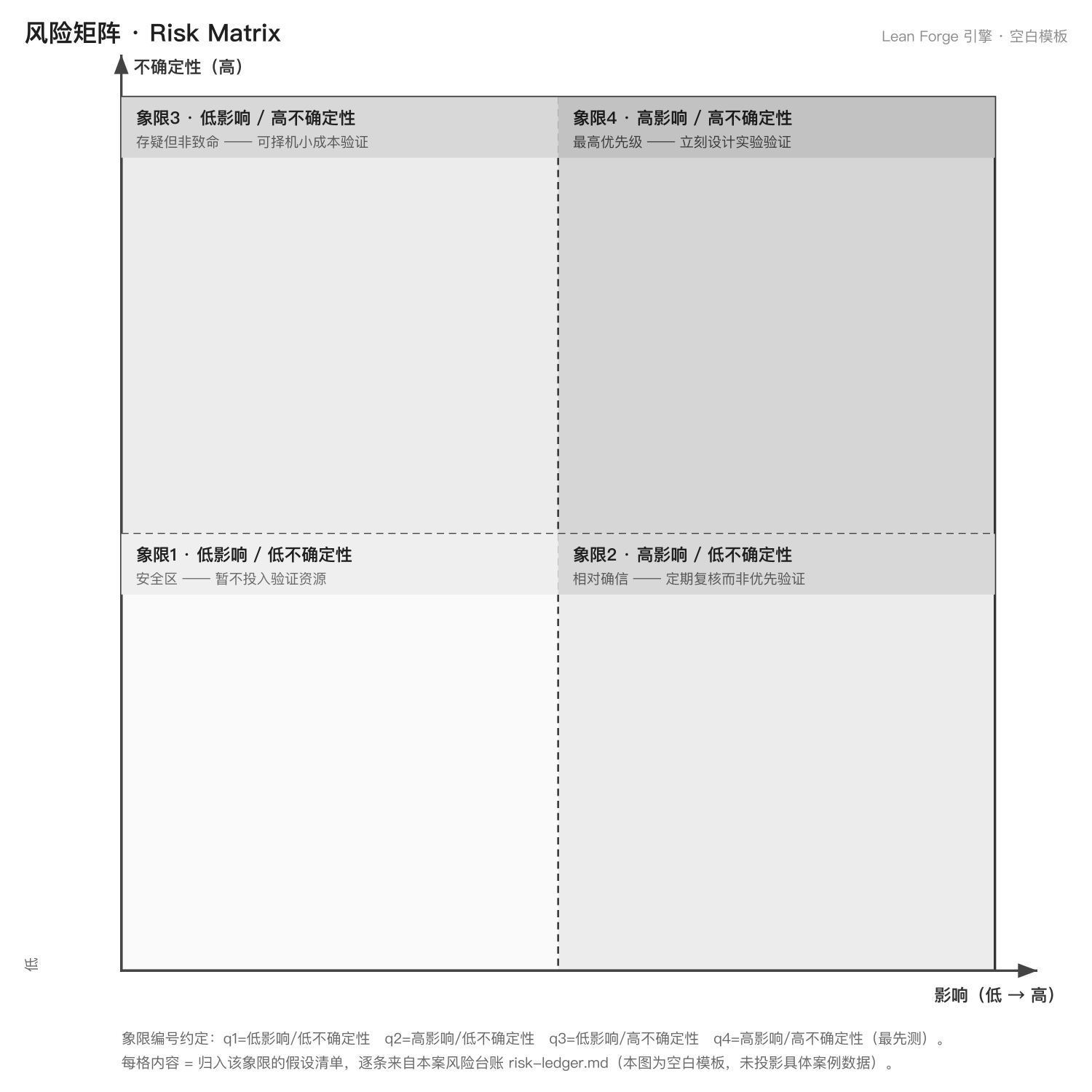
It plots the unresolved assumptions from the canvas into four quadrants by "impact × uncertainty." The top-right cell is the focus of the whole board—high-impact, high-uncertainty assumptions that nobody should decide on a hunch; you have to design an experiment immediately to test them. This card answers Gate 1.4: among a pile of assumptions, which one to test first.
Track B · Three structural diagrams for the validation/growth stage
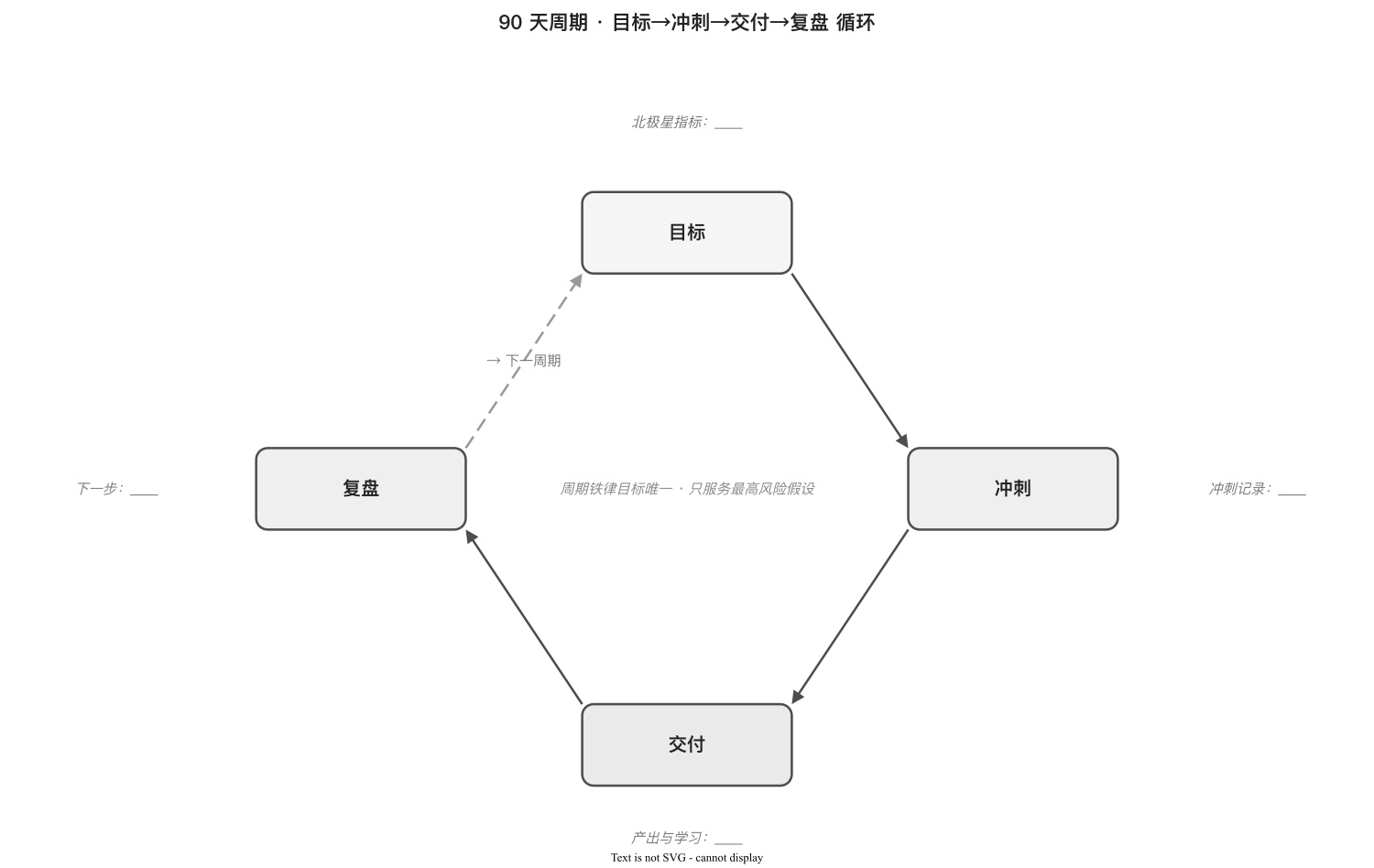
Goal → Sprint → Deliver → Review, one closed loop per sprint. The line at the loop's center—"a single goal · serving only the riskiest assumption"—is the discipline of the whole diagram, preventing the sprint from being diluted by odd jobs done on the side. This diagram answers Gate 2.4: what was learned this sprint, and where to aim the next one.
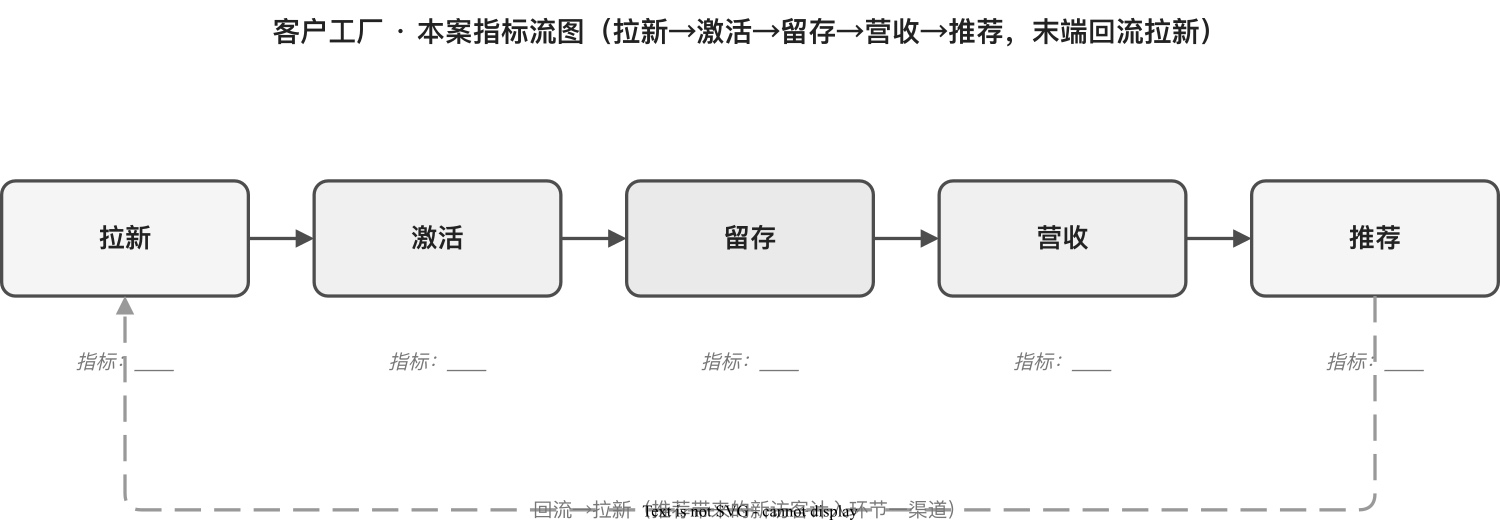
Acquisition → Activation → Retention → Revenue → Referral, five loops strung into a production line, with referral at the tail feeding back into acquisition. Whichever loop turns slowest is the current output bottleneck—the theory-of-constraints logic of "grab the slowest process" is directly visualized on this diagram. This diagram answers Gate 3.2: which loop is the company actually stuck at right now.
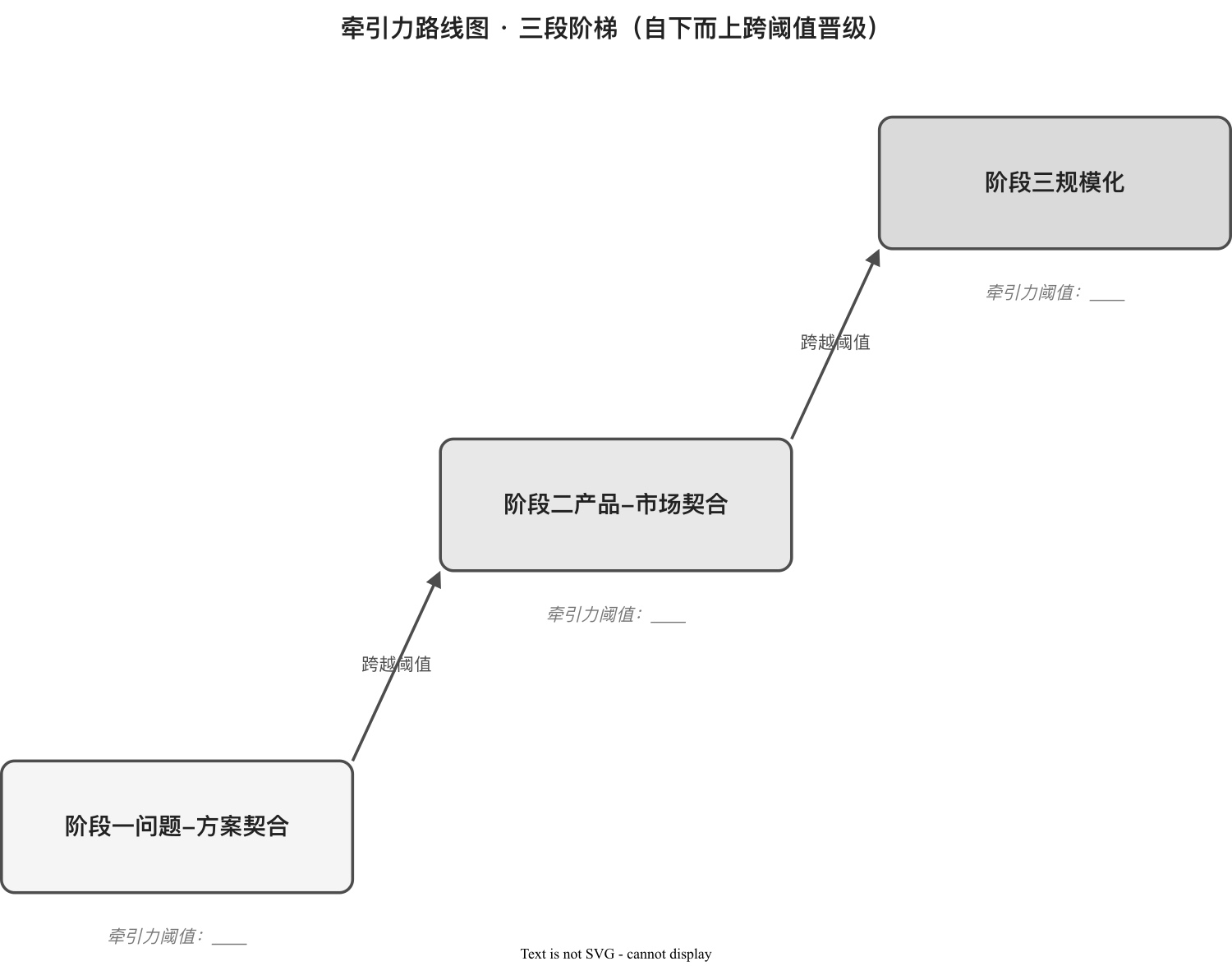
A three-stage ladder from bottom to top: Problem-Solution Fit → Product-Market Fit → Scale, each rung with a crossing threshold. It answers the question founders most easily deceive themselves about—Gate 3.3: should you keep polishing the product now, or can you hit the gas and scale?
The five diagrams together form a toolbox, corresponding to the complete judgment chain of lean startup from "thinking it through" to "selling it": two cards handle static diagnosis in the design stage, and three structural diagrams handle dynamic tracking in the validation and growth stages. For Robert himself, this is an inventory-taking, tipping out the Forge's tools and counting them up—after building for so long, how many real weapons are there? For the tryway.cc front end to be built later, these five diagrams are themselves a ready-made capability-showcase asset, with no need to start a separate demo from scratch.
The Most Honest Part of a System: Its Blind Spots
The value of a tool lies in how honest it is about its boundaries. After the first version of this engine ran through a real case, it exposed several genuine blind spots—and the most fatal of them wasn't deduced on paper; it was where the engine flinched on the spot on a real business.
That was a case of a chain of stores that had actually been operating for years (identity and industry details omitted). Of its ten risk assumptions, seven fell into the single quadrant of "high impact, high uncertainty." At the time the engine used the "impact × uncertainty" quadrants to rank risk—but when all seven assumptions crowded into the same quadrant, the quadrants could no longer distinguish priority. In the end the system couldn't produce "which one to test first" and could only hand over a vague "tied cluster of bottlenecks."
This exposed a set of blind spots:
| Blind spot | The underlying flaw |
|---|---|
| Risk quadrant crowding | The two axes only split "high / low," four buckets. As soon as a business gets complex, multiple assumptions crowd into the "most dangerous" quadrant at once, and ranking loses its resolution. |
| Missing "not applicable" state | The state machine defaults to "an idea being born walks from design to growth." But a business that has operated for years, whose demand was validated long ago, doesn't need to mechanically walk through "problem exploration" to prove someone wants it—yet the engine had no formal skip mechanism. |
| Adversarial review is optional | The devil's-advocate mechanism is off by default. For a tool whose whole reason for being is "filtering self-deception," making the adversarial check optional is a philosophical soft spot. |
Blind spots aren't scary; pretending they don't exist is. The truly interesting part is the next step: how should these blind spots be fixed?
Fixing at the Source: The Neglected Theory of Constraints
In fixing the blind spots, we did something counterintuitive—instead of rushing to invent a patch ourselves, we went back to Maurya's original book and checked line by line: had the methodology itself actually solved these problems?
The result was sobering: most of the blind spots weren't a gap in the methodology—the engine simply failed to faithfully encode what the original book already laid out well.
Take the most fatal "quadrant crowding." The first version of the engine treated the "impact × uncertainty" quadrants as the main workhorse for ranking. But open Chapter 6 of the original book, and Maurya ranks risk with something else entirely—he uses the theory of constraints (from Goldratt's The Goal (The Goal)): any system at any moment is limited by a single weakest link; treat the business model as a production line from customer acquisition to monetization, find the currently slowest process, and that is your highest-risk assumption. Improving any other process won't raise overall throughput—putting effort into a non-bottleneck is premature optimization.
In other words, the engine had the priorities backwards: it made the intuitively handy quadrants its workhorse and neglected the original book's true systemic skeleton.
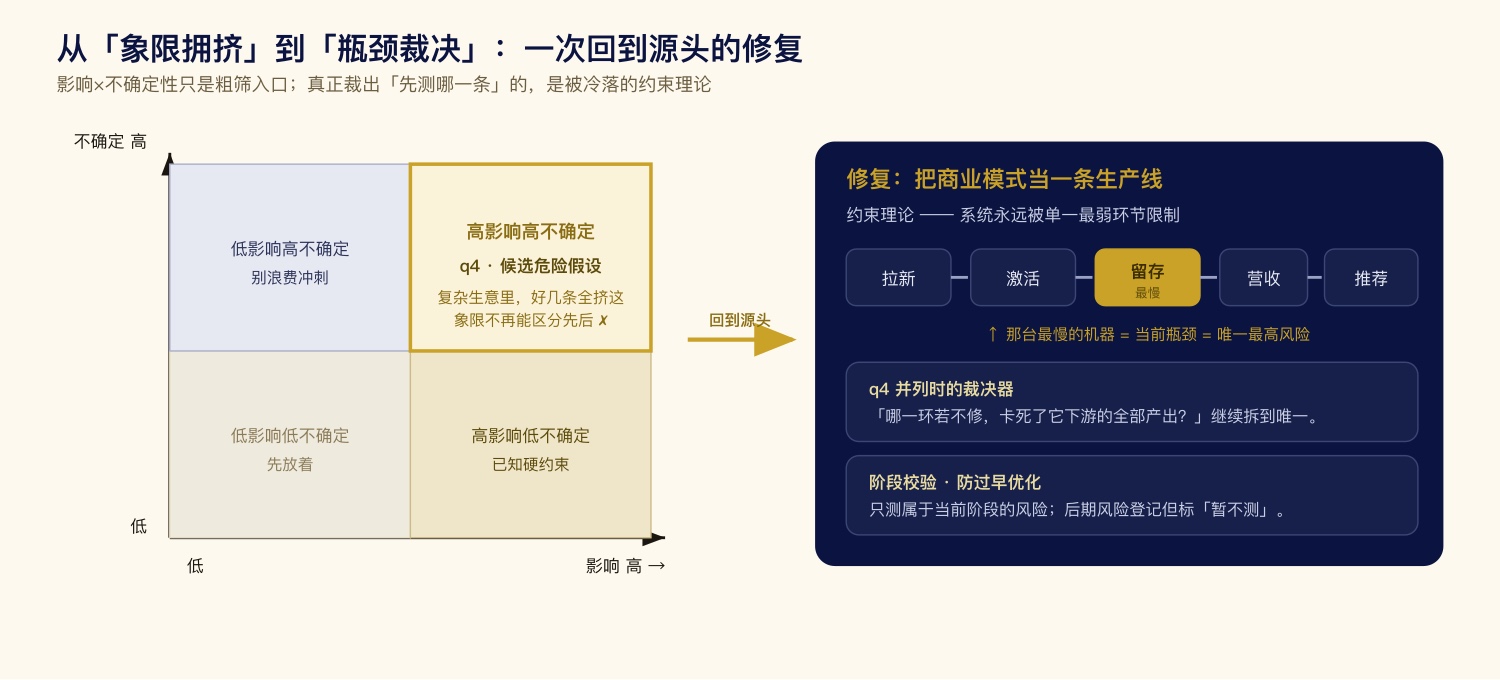
The fix therefore becomes clear: restore the theory of constraints to the first-order ranking position, and demote the quadrants to a coarse-filtering entry point. When several assumptions all crowd into the "most dangerous" quadrant, don't stop at "tied bottlenecks"—keep disassembling the production line, asking "which link, if left unfixed, would jam all the downstream output," until you rule out the single slowest machine. Back to that chain-store case: rather than agonizing over whether "location judgment" or "negotiation execution" matters more, better to ask "which single thing is the process actually jamming the opening of the next store"—and the answer surfaces.
The other two blind spots also found their remedies in the original book:
- "Not applicable" state → Chapter 4 of the original book already has "tackle the riskiest assumption in stages": which stage you're in determines which assumption is riskiest. A business already in operation is inherently at a later stage; you enter from the stage it's in, and prerequisite gates already satisfied by operating data needn't be mechanically re-walked. The engine added a "loading triage" that first sets the stage, then walks the gates.
- Optional adversarial review → Chapter 2 of the original book explains the "innovator's bias" thoroughly: entrepreneurs subconsciously fabricate problems to prove that the solution already in their head is right. Its remedy isn't bolting on a devil's-advocate character, but a structural hard rule—every "problem" must be able to point to the customer's existing alternative they are using today; if you can't say how the customer makes do now, the problem was most likely reverse-engineered into existence. The engine promoted this from a "reference lens" to a "hard gate."
The real takeaway of this fix wasn't the patch itself, but a methodological reminder: when an engineering implementation has a problem, don't rush to invent your own; go back to the theoretical source and check it against the original once, and the answer is often already written there.
One Layer Deeper: Why This Is a "Trustless" Design
Now back to the line planted at the opening—Lean Forge and Bitcoin share the same skeletal frame.
First we must be clear about an easily overstated version: if the claim is "equally large historical impact" or "equally hard technical breakthrough," it doesn't hold. Bitcoin solved Byzantine consensus, a cryptographic breakthrough at the money-protocol layer, and created a trillion-dollar asset class; Lean Forge is application-layer knowledge engineering, an engineering encapsulation of a methodology. The orders of magnitude aren't in the same league.
But there is a version that holds, and quite powerfully—they are the same kind of design philosophy:
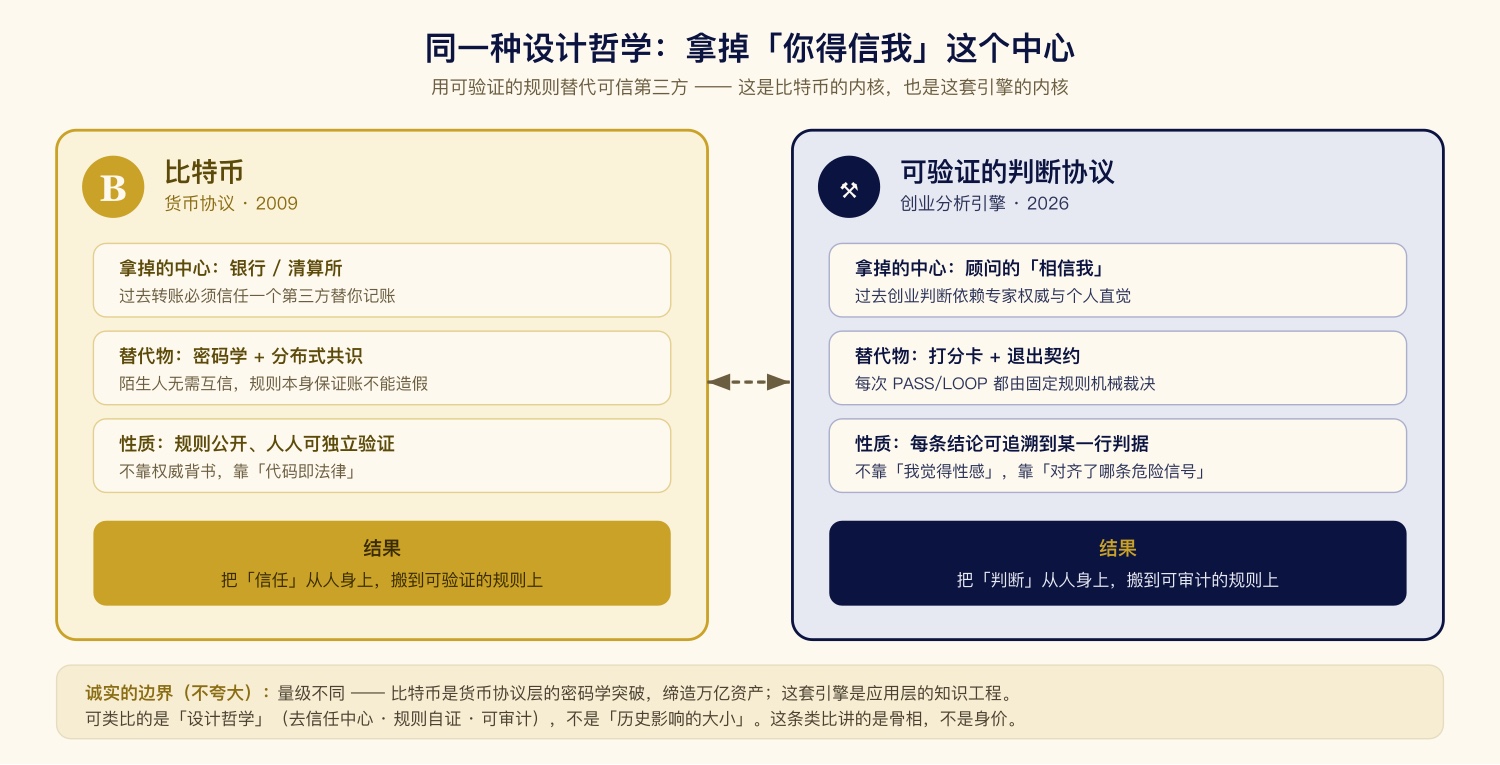
| Bitcoin | A verifiable judgment protocol | |
|---|---|---|
| The center removed | Banks / trusted third parties | The consultant / expert's "trust me" |
| The substitute | Cryptography + distributed consensus | Scorecards + exit contracts |
| Shared nature | Rules are public and independently verifiable by anyone, relying on no authority's endorsement | Every conclusion traces to a specific line of criteria, not on "I find it sexy" |
| The core in one sentence | Move trust off of people and onto verifiable rules | Move judgment off of people and onto auditable rules |
So an honest way to put it is: if Bitcoin is the trustlessness of money, then this engine is the trustlessness of startup judgment—the orders of magnitude of value they create are worlds apart, but their method of solving the problem comes from the same school: replace a "center you must trust" with a set of rules anyone can independently verify. This line is about skeletal frame, not net worth.
Closing
A good analysis system deserves to be taken seriously on two counts.
One is its machinery: auditable judgment, separation of concerns, progressive disclosure saving compute, anti-self-deception as the default posture—these make it not just "a big prompt" but a genuine engine.
The other is the posture it takes toward its own defects: blind spots are honestly laid on the table, and the fix isn't a hunch but a return to the theoretical source, restoring the neglected theory of constraints to the position it deserves. A system that can repair itself this way is far more trustworthy than one that "looks perfect."
And its deepest design intuition—moving trust off of people and onto rules—comes from the same school as Bitcoin. That point deserves to be spelled out.
Sources
- About Ash Maurya — LEANSTACK
- Ash Maurya — Entrepreneur.com
- Ash Maurya, Running Lean (Running Lean)
- Eliyahu M. Goldratt, The Goal (The Goal)—the original text of the theory of constraints