


Quick overview · TL;DR · definition · FAQ
TL;DR
- The core of a 24/7 automation system is not whether a script can run, but whether failures in scripts, hosts, networks, APIs, and alerts can be detected and recovered.
- Reliability comes from three things: device separation, layered monitoring, and redundant paths. Business logic is only part of the system; failure-path design determines whether it can run unattended.
- The most dangerous mistake is often not having no monitoring at all, but treating edge-triggered alerts as if they were level-triggered checks.
- A production automation system should answer: who watches the business, who watches the watcher, who detects host-level failure, and who takes over when the main path breaks.
Definition
A production-grade 24/7 automation monitoring system is an automation architecture designed to run unattended for long periods. It does not merely execute business actions; it continuously checks processes, hosts, networks, dependencies, alert channels, and recovery paths, leaving visible signals or automatic fallbacks when any link fails.
FAQ
Why is a working script not enough to count as a production system?
Because "working" only proves the happy path. A production system must also prove the failure path: network loss, host shutdown, API timeout, full disk, stuck process, or failed notification must still be detected, recovered, or at least made visible.
Why does monitoring need "who watches whom"?
A monitor is also software. It can crash, lose network access, or be misconfigured. One layer of monitoring can detect business failure, but not necessarily the monitor's own disappearance; layered monitoring separates business, process, host, network, and external observation points.
What is the difference between edge-triggered and level-triggered monitoring?
Edge-triggered monitoring fires when a state changes. Level-triggered monitoring keeps confirming that an abnormal state still exists. Unattended systems need level-style confirmation because the worst failure is not a bell ringing once, but the bell failing while the system remains broken.
References and Further Reading
systemdservices, timers, and watchdogs for process supervision and scheduled checks.- OpenWrt / VPS / local control-hub architecture for separating gateway, execution, and decision layers.
- Reliability engineering: single points of failure, redundancy, health checks, alert fatigue, and failure-domain isolation.
- Related TryWay topics: AI memory systems, RAG retrieval systems, CLI automation, and long-term operations.
I. Real Engineering Lives on the Failure Path
A script that only runs the "happy path" and a production-grade system may look nearly identical at the code level. The difference hides where you cannot see it:
- A happy-path script assumes the network is always up, the API always returns on time, the machine is always awake, and it itself never crashes.
- A production-grade system assumes that every one of those will eventually break, and it keeps an escape route ready for each way it can break.
There is one rule of thumb worth committing to memory first: in a truly 24/7 system, business logic often accounts for only about thirty percent of the code; the remaining seventy percent is "monitoring whether it's actually doing its job" and "what to do when some link in the chain fails." The rest of this essay dissects that seventy percent.
The sample system is made of four parts: an enterprise-grade router (the network gateway), a cloud VPS (the frontline executor), a local Mac control hub (perception and decision-making), plus an on-chain asset monitoring and automated-response system that runs on the VPS and must react to external events within seconds. Compact in size, complete in its organs — every pitfall a production-grade system ought to hit, this one hit every last one.
II. Three Devices, Each to Its Own Duty
The first layer of reliability isn't in the code — it's in the architecture: no single machine is simultaneously the brain and the limbs.
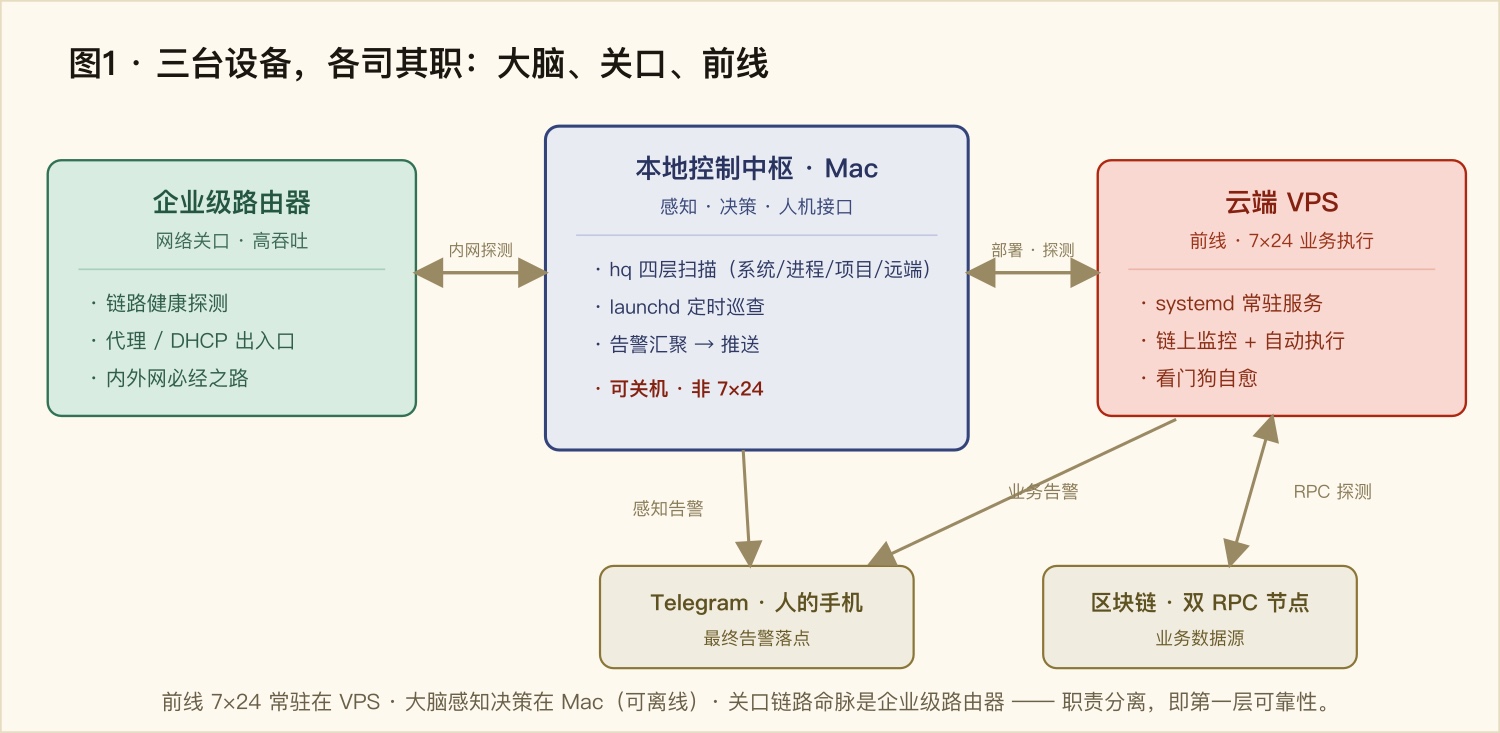
| Device | Role | What it runs | Why it lives here |
|---|---|---|---|
| Enterprise router | Network gateway · link lifeline | Link health, proxying, DHCP, high-throughput forwarding | The mandatory gateway for all intranet traffic; it decides whether the other two can even talk to each other |
| Local Mac control hub | Perception · decision · human interface | Global scanning, scheduled patrols, alert aggregation and push | Whatever a human needs to see, decide, or aggregate lives here — it's allowed to be powered off |
| Cloud VPS | Frontline · 24/7 business execution | Resident services, on-chain monitoring, automated execution, watchdog | Anything that "must never stop for a moment" can only live in the ever-awake cloud |
One line captures the crux: the control hub is allowed to sleep; the frontline executor is not. So duties split this way — "must be 24/7" goes on the VPS, "needs a human in the loop" goes local, "the network lifeline" is the router. The separation is itself a form of redundancy: when the local Mac's lid is shut and it's asleep, the business on the VPS keeps running unaffected — something a single-machine "brain-and-limbs-in-one" design simply cannot do.
III. Concentric Circles: Who Is Watching Whom
This is the single most important diagram in the essay.
The most common beginner's misconception is to think "I added monitoring" equals "I installed an alarm." The truth is: monitoring is layered, and —
each layer can only see the class of failures its inner layer is blind to.
Picture it as an onion, wrapped from the innermost business logic outward, layer by layer, to the outermost "human attention":
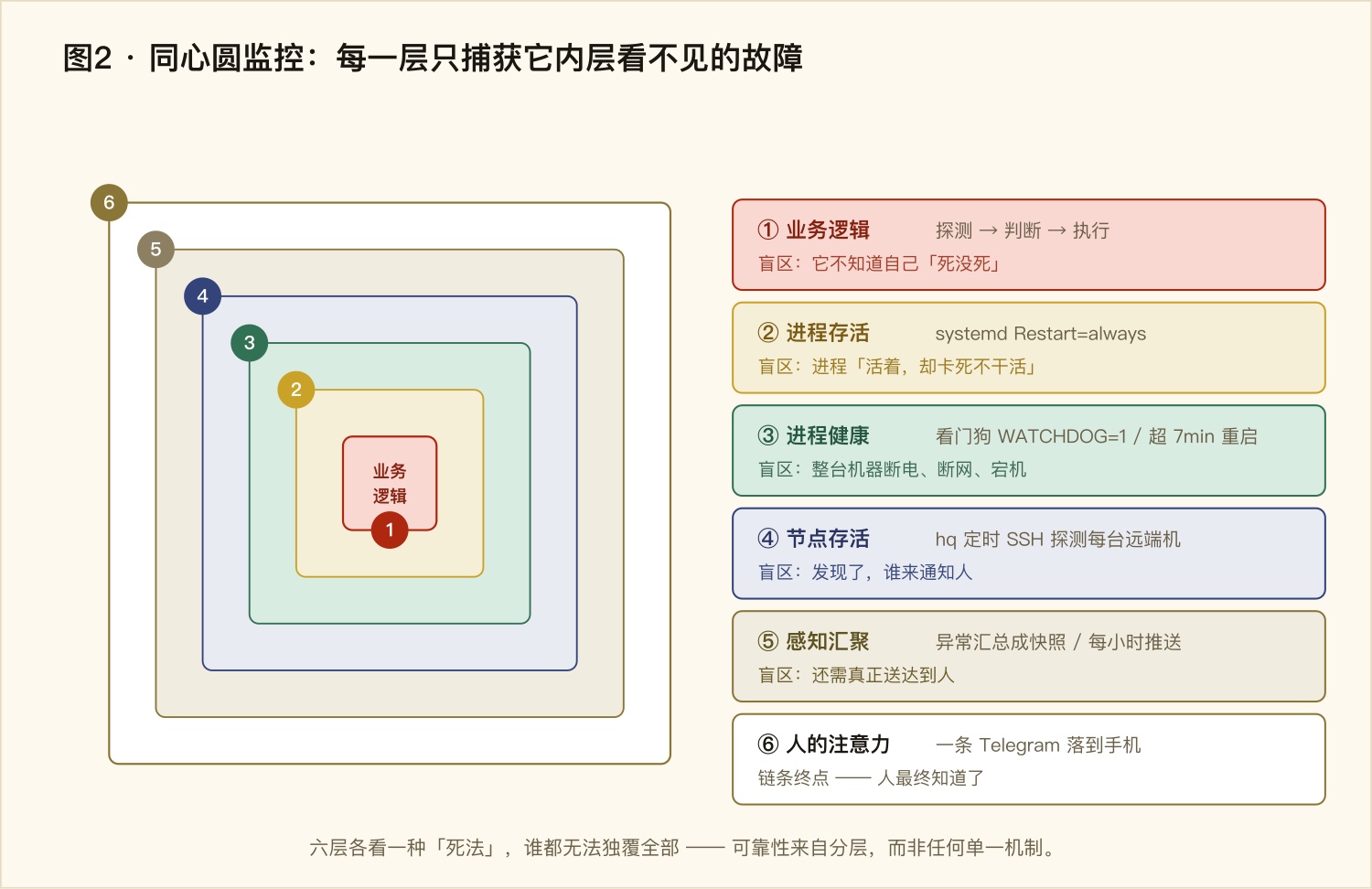
| Layer | What it watches | Mechanism | What it can't see (handed to the next layer out) |
|---|---|---|---|
| ① Business logic | Probe → judge → execute | The script's main loop | Doesn't know whether it itself has "died" |
| ② Process liveness | Whether the process has exited | systemd Restart=always | A process that's "alive but frozen and not working" |
| ③ Process health | Whether the live process is actually working | Watchdog WATCHDOG=1 / restart after 7 min | The whole machine losing power, network, or crashing |
| ④ Node liveness | Whether the entire remote machine is online | Control hub's scheduled SSH probe | Once found — who tells the human |
| ⑤ Perception aggregation | Rolling up all anomalies | Snapshot + hourly push | Still needs to actually reach a person |
| ⑥ Human attention | Whether the human ultimately knows | A push landing on a phone | — the end of the chain |
Reading down layer by layer, you find every layer has a hole it can't fill itself, which is precisely the reason the next layer exists:
- Layer ②'s blind spot gave rise to Layer ③. When a process crashes and exits,
Restart=alwaysbrings it back up within seconds — but what if the process didn't crash, is still there, yet is frozen on some call and going nowhere? Layer ②'s criterion is "is the process present," and it cannot see "present, but not working." - What fills that hole is the watchdog: every time the process finishes a round of work, it proactively shouts to the system "I'm still alive"; if it fails to shout within a set time limit (7 minutes here), the system rules it a zombie and forcibly restarts it. This layer specializes in "alive but not working."
- But Layer ③ has its own blind spot: if the entire VPS loses power, network, or crashes, the watchdog goes down with it and can't sound the alarm. Hence Layer ④ — the local control hub probes each remote node on a schedule from another machine, and only at this layer is a wholesale loss of a machine discovered.
The value of this chain lies precisely in dividing the labor of watching different ways to die. No single layer can cover all failures on its own; stacked together, they weave a net with no obvious holes.
IV. The Economics of Frequency: The Cost of a Miss Sets the Tempo
If you're going to monitor, how often should you look? Once per second, uniformly? Too expensive, and unnecessary. The correct answer is a plain piece of economics:
Patrol frequency is proportional to "the cost of missing one detection."
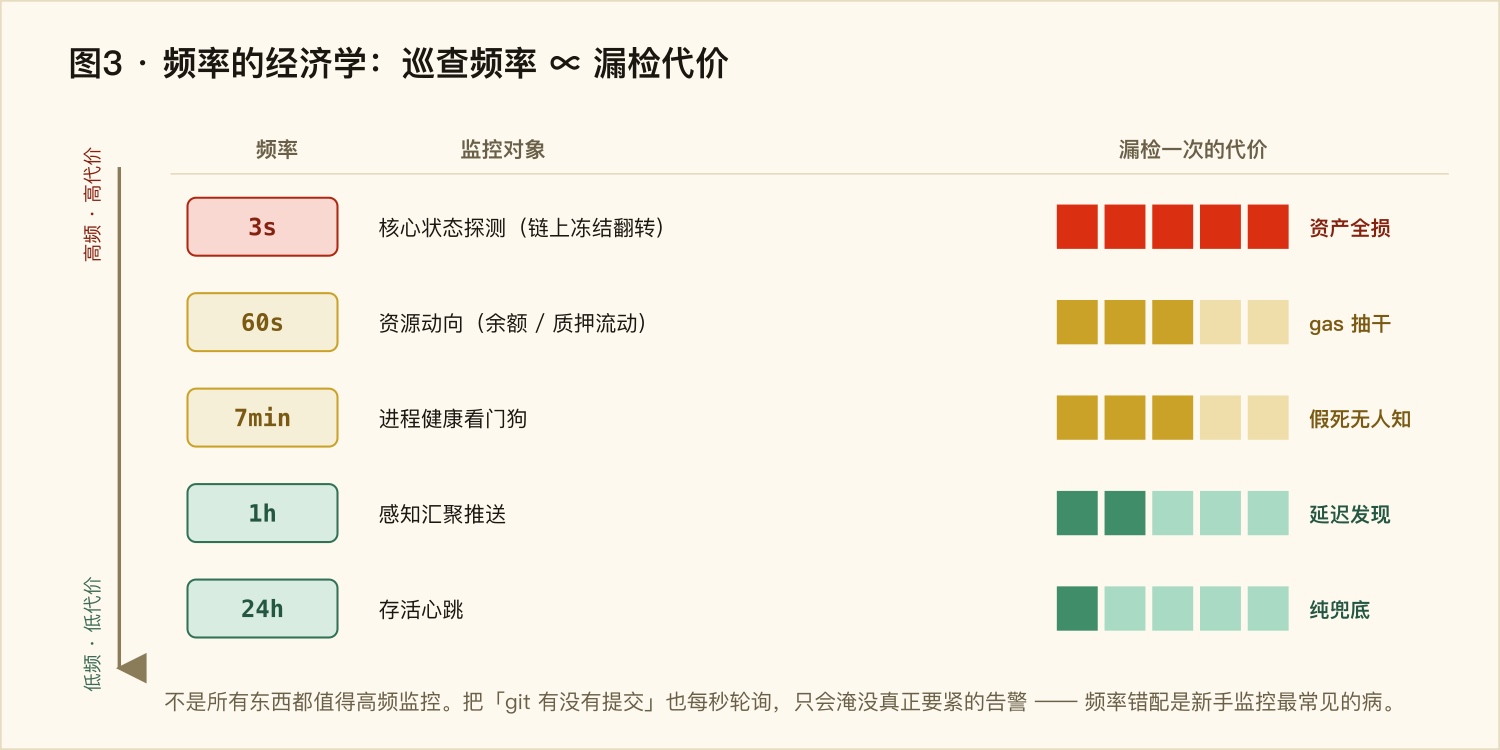
| Frequency | What's monitored | Cost of one miss |
|---|---|---|
| 3 seconds | Core state probe (external event flip) | Total loss of assets — every second has a price |
| 60 seconds | Resource movement (balance / resource flow) | Important but not fatal; minute-level is enough |
| 7 minutes | Process-health watchdog | A zombie goes unnoticed; but "freezing" itself is rare, no need to go tighter |
| 1 hour | Perception-aggregation push | Discovering a failure an hour late is usually still salvageable |
| 24 hours | Liveness heartbeat | Pure backstop, only to prove "I'm still here" |
A counterintuitive but crucial corollary: not everything deserves high-frequency monitoring. Polling "whether the git repo has committed on time" every single second only burns resources and drowns the alerts that actually matter under noise.
Frequency mismatch — the urgent gone slow, the trivial gone fast — is the most common ailment of a beginner's monitoring system. Poll a core event at hourly cadence and you'll miss the life-saving window; refresh an irrelevant status at second-level and you'll train yourself into "cried wolf" numbness. Align each item's monitoring frequency with "how much a single miss costs," and this system's patrol tempo layers itself naturally.
V. Six Forms of Redundancy: A Single Point of Failure Need Not Be Fatal
Monitoring is responsible for finding problems; redundancy is responsible for not collapsing when a problem occurs. The redundancy in this system sorts cleanly into six kinds — the key being that each kind plugs a different single point.
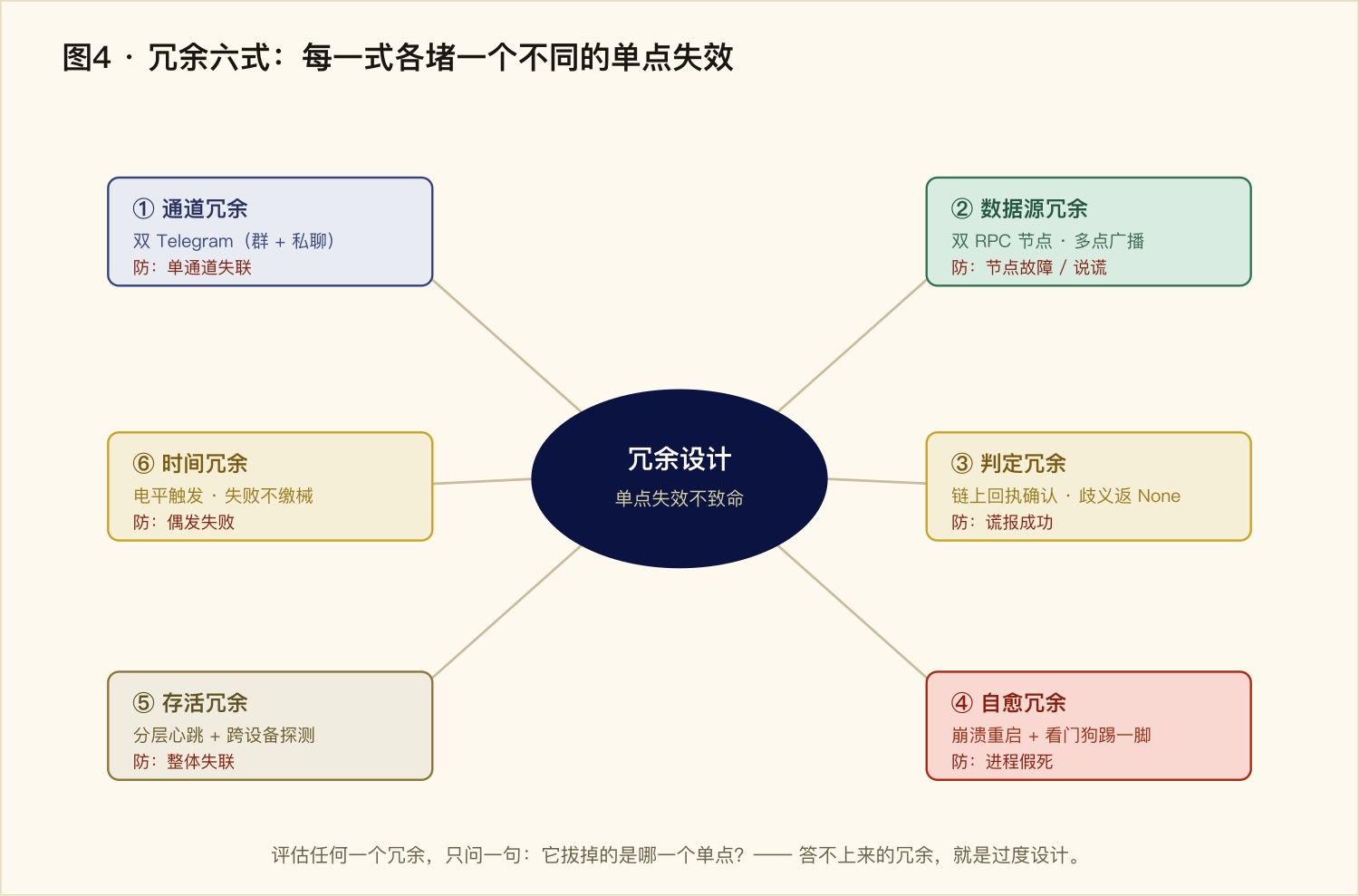
| Form | Practice | The single point it pulls out |
|---|---|---|
| ① Channel redundancy | Alerts go over two Telegram channels at once (a group + a direct message) | A single channel going dark |
| ② Data-source redundancy | External state is queried from two independent nodes; actions are dispatched to several nodes at once | A single node failing or "lying" |
| ③ Judgment redundancy | Never trust intermediate signals; go by the authoritative result, and rule "unknown" on any ambiguity | A false report of success |
| ④ Self-healing redundancy | Auto-restart on crash; on a freeze, the watchdog kicks it into a restart | Process zombification |
| ⑤ Liveness redundancy | Layered heartbeats + cross-device probing; there's always a layer that can prove the whole is still alive | Total loss of contact |
| ⑥ Temporal redundancy | Failure doesn't mean giving up; if the condition still holds, try again next round | An occasional single-shot failure |
Two of these forms deserve unpacking, because they're where beginners most easily go wrong:
③ Judgment redundancy — do not trust intermediate signals. An action having "already been dispatched" does not equal "succeeded." The right approach is to confirm by querying back the authoritative final result, not by looking at "whether the dispatch was accepted." Likewise, when a state query returns something ambiguous (half a payload, an error code, an empty response), you must never guess a direction on its behalf — treat it as "unknown" without exception; rather re-query next round than fire an irreversible action on a guess. This one was bought with a real incident: "reporting a failed operation as a success."
⑥ Temporal redundancy — a failure is merely "this round didn't land." It leads directly into the next section, and it's the most expensive lesson in the whole system.
To evaluate any piece of redundancy, you really only need to ask one thing: which single point does it pull out? If you can answer, it earns its place; if you can't, it's most likely over-engineering that only makes you "feel safer."
VI. Edge vs. Level: A One-Word Difference Between Life and Death
This is the most expensive lesson in the entire system, and it deserves its own section.
The early version used edge-triggering: it acted only "in the instant the state flips." Logically natural — the moment the condition is met, charge.
The problem is: what if that one shot doesn't land? A network jitter, insufficient resources, a node returning half a payload… so long as that one attempt fails, and "the instant of the flip" has already passed and will never come again, the system is permanently disarmed. Even if the condition truly holds forever afterward and execution truly remains possible, it won't move — worse, it thinks everything is fine.
Rebuilt, it switched to level-triggering: it doesn't watch "the instant of the flip," only "whether the condition currently holds." As long as "executable ∧ not yet succeeded," it retries every round; if one fails, the next picks it right up, until it confirms the job is truly done and only then stops.
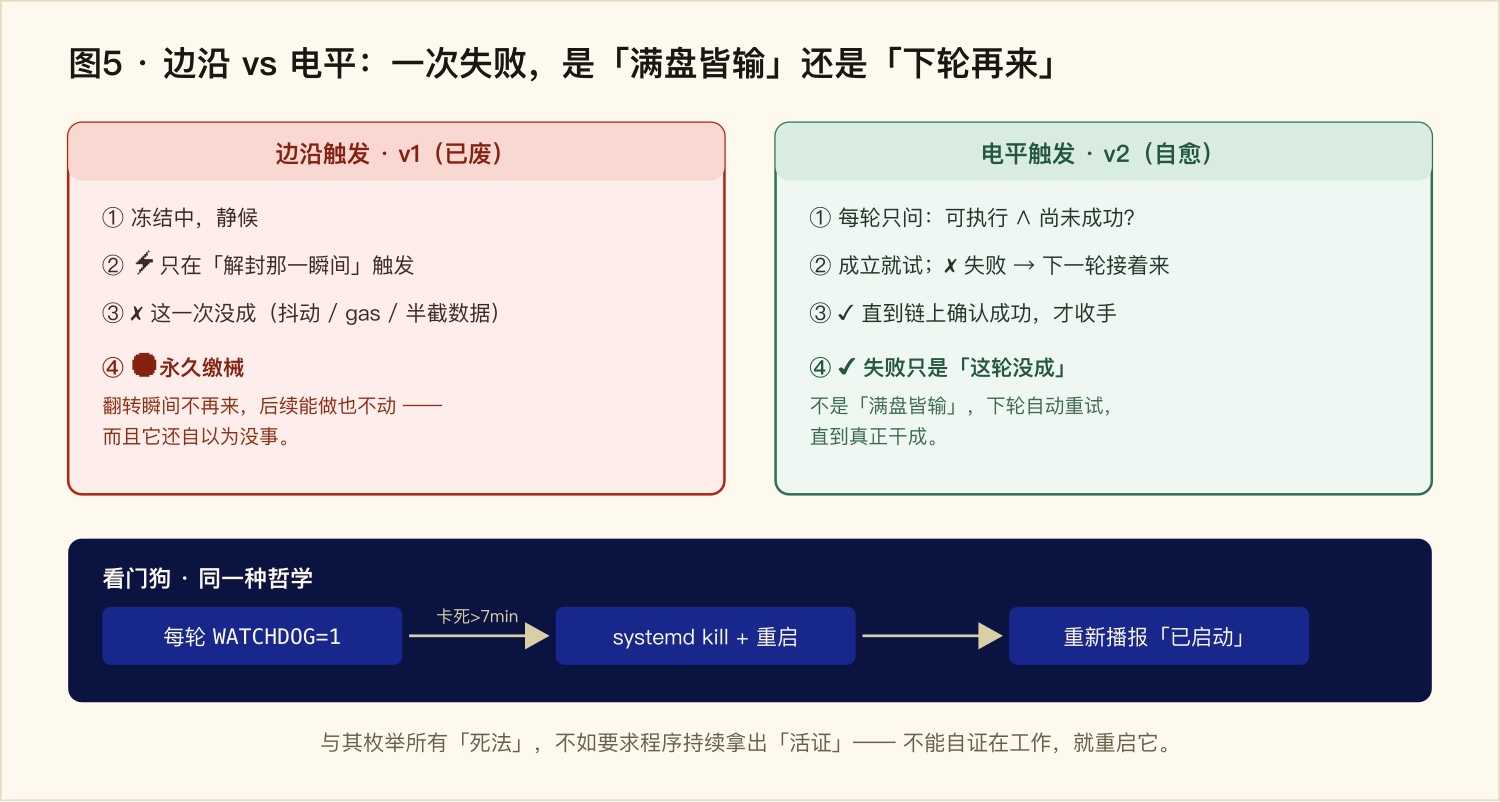
The distinction sounds abstract, but its cost is extremely concrete:
| Edge-triggered (v1) | Level-triggered (v2) | |
|---|---|---|
| Consequence of one failure | Total loss, and silent | Just "this round didn't land," auto-retries next round |
| Self-healing | None — miss the instant and it's permanently dead | Yes — keeps trying as long as the condition holds |
| Failure visibility | Pretends nothing happened — the most dangerous | Leaves a trace every round, observable |
The accompanying watchdog is, in fact, another application of the same philosophy. The watchdog doesn't go "detect some specific failure" — it inverts the problem, demanding that the process continuously prove it is working: shout "I'm still alive" after each round of work, and get restarted if it can't shout.
Rather than enumerate every possible way to die, require the program to keep producing "proof of life." You can never list in full how a system might die; but you can require it to "restart if it can't prove it's working." This is the flip from "exhaustively enumerating failures" to "demanding proof of life," and it's where the watchdog's real power lies.
VII. The Philosophy of Alerting: Better to Wake You Than to Go Blind
The far end of monitoring and redundancy is a single message landing on a human's phone. This last link has its own craft, and a few battle-tested principles:
| Principle | Explanation |
|---|---|
| Severity tiers | Only the fatal (assets / a whole machine) gets Critical, worth waking you at midnight; the routine (a repo long uncommitted) drops to Warning, aggregate is enough |
| Dedup + cooldown | The same "low on fuel" fires at most once per hour; otherwise it floods the screen, which equals not alerting at all |
| Silence the known-harmless | A laptop taken out the door, an intranet probe failing to reach the router — this is the normal "leave home, go offline"; it shouldn't alert, or you cry wolf daily and go numb before the real wolf comes |
| Alerts should self-attest | After a process restarts, it proactively sends "I'm back up," so you know it just went through a self-heal rather than restarting silently and pretending nothing happened |
Of these, "silence the known-harmless" tests your sense of proportion the most. In this system's perception engine, the "remote node offline" alert deliberately skips that enterprise router — because the most common reason it can't be probed is that a local device was carried out the door (no longer on the same intranet), which is a known-normal state; what truly warrants waking a person is that VPS, which is supposed to be online 24/7, going dark. Sift the known-normal fluctuations out of your alerts, and every one that remains becomes worth looking up for. The enemy of an alerting system was never just "false negatives" — "cried wolf" over-alerting will disable it just as surely.
VIII. Closing: Reliability Is an Onion, Peeled One Layer at a Time
Looking back, there's no single "silver bullet" anywhere in this system. It's reliable because a string of plain things are stacked together:
Duties split across three devices → six monitoring layers each watching a different way to die → six forms of redundancy each plugging a different single point → frequency allocated by cost → triggering by level, not edge → alerts tiered, deduped, then handed to a human.
Each layer, viewed alone, is utterly unremarkable; stacked together, they become "you dare not look at it for three months."
If you take away only one line from this essay, I hope it's this:
Business logic decides whether it can work; monitoring and redundancy decide whether it can work unattended for the long haul. The latter is the whole meaning of the words "production-grade."